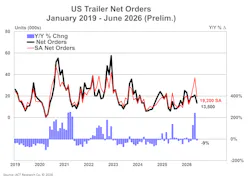
June trailer orders were like the children of Lake Wobegon: “above average” but not really anything to brag about.
Specifically, the U.S. heavy-duty trailer market experienced an expected seasonal slowdown in June, following atypically strong order activity in April and May, according to reports from industry forecasters FTR and ACT Research.
While demand remained solid for a traditionally weak month, net orders fell significantly month-over-month as fleets concluded their current-year procurement decisions.
The industry continues to navigate a selective, replacement-driven recovery rather than a broad expansion cycle, hampered by high equipment prices and excess capacity.
“After several months with net orders behaving counter to historical patterns, the seasonal slowing of orders arrived with the June data,” said Jennifer McNealy, director CV market research and publications at ACT Research. “Typically, March starts the seasonal slowing of orders, as fleets have made their decisions for current-year needs and OEMs start to build down the backlog. June traditionally marks the third weakest order month of the annual order cycle. That said, this year’s cycle has been anything but ordinary: the order upticks that should have started in September or October of last year didn’t actually begin until December.
“The atypical strength in orders in April and May reflects improving trucking fundamentals, buttressed by rising freight rates.”
Order trends, segment performance
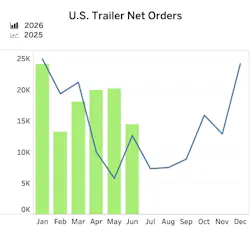
Preliminary data for June 2026 shows net trailer orders between 13,500 and 14,474 units. FTR reports a 28% month-over-month decline, while ACT Research estimates a 35% drop from May’s intake.
Despite the monthly pullback, the order volume remained 8% above the 10-year June average of 13,379 units.
Growth in June was primarily driven by refrigerated van and flatbed segments, which improved year-over-year. Conversely, dry van demand weakened after several months of relative strength.
Most other segments showed improvement compared to the previous year, suggesting a broad but gradual stabilizing of the market. Analysts note that the atypical strength seen earlier in the spring was likely a temporary surge rather than a sustainable new run rate.
Production and backlog dynamics
Manufacturers continue to maintain a cautious stance, aligning production levels with actual demand.
June builds rose 6% month-over-month to 17,633 units, yet remained 1% below the previous year. Year-to-date production remains nearly flat, down just 0.5% compared to 2025.
The industry is seeing a disconnect between truck and trailer demand; while trailer orders have faced volatility, North American Class 8 net orders have remained more resilient, as fleets prioritize power units over trailers.
High cancellation rates—recorded at 1.9% of the backlog in May—highlight ongoing caution among purchasers. However, low current cancellations in June suggest that remaining order commitments are stable.
“Regardless of the timing, the order upticks certainly were welcome, but were premature in terms of 2027 order timing and the opening by OEMs of next year’s calendars,” McNealy concluded. “Additionally, caution remains a strategy for some trailer purchasers. Rates are rising now, but the past few years have been hard for carriers, and now the challenges of strong pent-up demand and the risks of higher maintenance costs and downtime to repair rather than purchase new equipment remain as counter-weights to their decision-making process.”
Regulatory risks add to cost pressures
The trailer industry faces mounting cost pressures due to shifting trade policies. Section 232 steel and aluminum tariff changes, along with pending antidumping and countervailing duties on van-type trailers, are driving the Producer Price Index (PPI) higher. Recent data indicates a sharp jump in prices, suggesting these policy-related costs are already being passed on to equipment buyers, noted Dan Moyer, senior analyst, commercial vehicles, for FTR.
“The main risk from these recent and pending policy decisions is that trailer sourcing shifts faster than domestic capacity can adjust,” Moyer said. “OEMs and suppliers with U.S.-based production could gain share and pricing power, but a sharp pullback from affected imports could tighten availability, extend lead times, and raise costs.
“The trade actions are, therefore, more likely to change where trailers are sourced and when fleets order, at least near term, than to create meaningful new demand.”
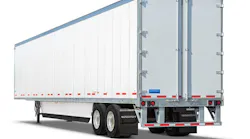 Wabash DuraPlate Dry Van
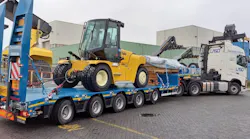 goldhofer_laso
About the Author
 Kevin Jones
Kevin Jones
Editor
Kevin has served as editor-in-chief of Trailer/Body Builders magazine since 2017—just the third editor in the magazine’s 60 years. He is also editorial director for Endeavor Business Media’s Commercial Vehicle group, which includes FleetOwner, Bulk Transporter, Refrigerated Transporter, American Trucker, and Fleet Maintenance magazines and websites.
Working from Beaufort, S.C., Kevin has covered trucking and manufacturing for nearly 20 years. His writing and commentary about the trucking industry and, previously, business and government, has been recognized with numerous state, regional, and national journalism awards.