2025 Trailer Output Report: Market declines, OEM strategies, and outlook for 2026
Key Highlights
- Trailer production in 2025 declined across major manufacturers due to economic and trade uncertainties, with Hyundai Translead and Great Dane experiencing reductions.
- OEMs have responded by shifting focus to higher-content, custom products, and maintaining operational efficiencies to navigate the challenging market environment.
- Industry experts highlight the importance of demand stability, freight rate increases, and easing material costs as key factors influencing a potential recovery in 2026.
- Trade tensions, tariffs, and rising raw material prices, especially aluminum, remain significant hurdles, impacting production costs and market confidence.
For more trailer output data:
Truck-trailer manufacturers in 2025 saw production totals fall: Not a surprise, but not the mid-year turnaround many expected.
For Jennifer McNealy, director, CV market research and publications at ACT Research, it’s all about demand.
“It's about the economy, and do fleets need to replace the equipment they have to do the job, number one?” she told TBB in early February. “Number two, do they have the money to purchase that equipment, and are they going to spend those dollars on the power units, or on the trailing equipment, or on some other type of investment?”
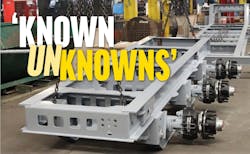
But no one really has the answer, just yet, and the uncertainty that characterized 2025 is carrying over into 2026. McNealy pointed to a number of “known unknowns" at the root of this uncertainty, and many of these market question marks were mentioned early and often in interviews with trailer OEMs participating in this annual report:
- the unprecedented three-year freight recession
- tariffs, on top of record-high aluminum prices
- a pending trade fight over imported trailers
- high interest rates
- regulatory uncertainty
“Really, we are where we were—we're still in this holding pattern,” McNealy said. “People are cautiously optimistic. Not that the New Year has flipped over to 2026 and 2025 is behind us, but later on into 2026 and what that will mean? We still have uncertainty. People have adjusted to it; they understand that it's a different climate than it was two years ago, but they're not sure.
“Will everything that's been put in place, stay in place? Are there new things that are going to come out and what will those look like? The challenge is that people really don't know if it's going to get better or worse. But I think people are optimistic. We see some freight rates that have risen—but it's not sustained until there are several months of rising. So that's kind of where we are right now.”
How have trailer OEMs gotten by? As mentioned in the comments below, hard-earned lessons from the COVID-19 crash are still fresh enough, even after the recovery boom. Along with running a tight operation, several OEMs have developed new products or shifted more custom, higher-content manufacturing to keep lines moving and the workforce engaged. Others had to lay people off. Several familiar names formerly on this report largely have shifted away from trailer manufacturing.
Yet some trailer builders have gone through with expansion plans, looking to be well positioned for a demand recovery. But be careful what we wish for.
“We're hearing from the manufacturers that there is a level of concern that, if the uptick happens slowly and gradually, we'll be fine and they'll be able to add capacity back and increase that build on a smoother trajectory upward," McNealy said. “If the order intakes happen en masse—if everybody wants to shove and push to get in line and that line gets long—we very well could have a backup like we saw a couple of years ago coming out of the pandemic.
“I think everybody's in agreement that it's coming; when and how quickly are the concerns and folks are trying to get prepared for that.”
Editor’s note: This survey does not attempt to report on the many small trailer manufacturing plants scattered throughout North America, so the total trailer build is somewhat larger than the numbers reported here.
This Trailer|Body Builders survey is put together by contacting a member of the management team at each manufacturing company. The ranking of the companies does not necessarily reflect their relative success in terms of profitability or revenue, but only the number of trailers produced. The dollar value of a trailer can vary greatly depending on the design, type of construction, materials used and quality level.
Below is how the individual trailer manufacturers reported their trailer production for 2025:

Hyundai Translead
Hyundai Translead of San Diego, California, produced 39,887 units in 2025, down 29%.
"Despite the challenges our industry faced in 2025, our commitment to our customers has never wavered,” said Sean Kenney, CEO of Hyundai Translead. "As we move into 2026, we are prepared for what’s ahead as we continue to remain true to our core principles and connecting what matters most - people, communities, and businesses.”
Trailers are built at the company’s plants in Mexico.
Great Dane
Great Dane built 24,525 trailers in 2025, down 32% from the previous year. The company also built over 1,600 truck bodies and dollies.
Great Dane commemorated its 125th anniversary in 2025.
Headquartered in Chicago, Illinois, and with additional corporate offices in Savannah, Georgia, Great Dane has manufacturing plants strategically located throughout the United States.
Wabash
Wabash shipped 22,770 new trailers in 2025, a 29% decrease compared to the year before.
Wabash also shipped 10,600 truck bodies, not counted in the rankings.
“While conditions on the ground are improving for our customers, we have limited visibility into timing, pace and sustainability of the freight market recovery. With that said, the underlying conditions for a strong trailer demand response are growing once the freight market recovery threshold is met and our customers look to recapture profitability and get back to a growth mindset,” President and CEO Brent Yeagy said. “But for now, our customers continue to defer capital spending decisions, and order patterns remain uneven, reflecting a highly managed near-term reality across freight, construction, and industrial end markets. While near-term conditions remain challenging, customer engagement around 2026 purchasing decisions is ongoing, and many fleet order commitments for the year remain open and active, a positive departure from historic norms for this period of the sales cycle for trailers.
“Based on these discussions and early order activity, we believe full-year 2026 revenue and operating margin is likely to be higher than 2025, even though the timing and shape of demand recovery remain uncertain.”
Headquartered in Lafayette, Indiana, Wabash designs, manufactures, and services a diverse range of products.

Stoughton Trailers
Stoughton Trailers produced a total of 15,600 units in 2025, across dry vans, refrigerated vans, grain trailers, and intermodal chassis—a 4% increase over 2024 despite a combined 20% market downturn in these categories.
“Given the challenging market conditions, 2025 was a strong year for the company,” said President & CEO Bob Wahlin. “We expanded our dry van market share for the third straight year, opened our new corporate headquarters, and strengthened our sales team and dealer network. We relaunched our intermodal container line and reconfigured our Evansville, Wisconsin, refrigerated trailer facility to triple capacity.
“With ongoing investments in automation and technology, we are well positioned to scale rapidly when the trucking equipment market rebounds.”
The company is headquartered in Stoughton, Wisconsin.
Vanguard National Trailer Corp.
Vanguard National Trailer Corp. produced 11,324 trailers in 2025, a 19% decrease from 2024.
Vanguard, started in Monon, Indiana, in 2003, has grown to be a premier manufacturer of dry and refrigerated trailers in North America.

EnTrans
EnTrans produced 6,004 trailer units in 2025, reflecting an 18% reduction from 2024, reported Jake Radish, president and COO, Engineered Transportation International.
“In 2025, industry demand declined materially, with the market down approximately 18% year over year. In response, EnTrans produced 6,004 trailer units, aligning output with customer demand and broader market conditions,” Radish said. “Volume adjustments reflected customer destocking activity and a cyclical normalization following the post-pandemic expansion, while we maintained a sharp focus on execution, cost control, and product mix optimization.
“Entering 2026, we see conditions stabilizing with early signs of improvement as fleet replacement activity resumes. EnTrans is well positioned with a diversified portfolio, disciplined operating cadence, and capacity flexibility to support growth as demand recovers, particularly in specialized and higher value transport segments.”
The company comprises Heil Trailer, Polar Tank Trailer, JARCO, and Kalyn Siebert.
XPO
XPO in Searcy, Arkansas, delivered 5,630 units in 2025, a 15% increase from the year before.
This includes equipment ranging from 28’, 48’, 53’ trailers, dollies and straight trucks, according to Paul Reed, manufacturing senior director.
“We look to have another solid year on trailer production,” Reed said. “We are adding straight truck boxes to our outside sales and look to grow it with our trailers.”
MAC Trailer Enterprises Inc.
MAC Trailer Enterprises Inc. built 5,375 trailers in 2025, down slightly at 5%.
MAC Trailer remained focused in 2025 on building valuable equipment, supporting its dealer network, and maintaining disciplined standards as the market continued to evolve, reported President of Sales Bill McKenzie. The company’s increasingly diverse product portfolio allowed them to remain competitive across multiple applications while continuing to gain market share in select segments.
“Having a broad and growing product lineup gives us the ability to adapt to changing customer needs without losing focus on quality or service,” McKenzie said. “Looking ahead to 2026, the company expects continued pressure from rising operational costs but remains confident in its ability to navigate them.
“We are committed to working through these market challenges while continuing to provide dependable products, supported by the strength of our dealer network.”
Fontaine Trailer Co.
Fontaine Trailer Co. manufactured 4,795 trailers in 2025, a 24% gain, the Alabama-based platform specialist reported.
Fontaine Trailer President Alan Briley credited new products launched in 2025 for pacing the improvement over the year before, but otherwise the company is “rising with the market.”
“From a flatbed perspective, whatever we've been in is certainly not the deepest correction that we've ever seen—but it's the longest correction of my career,” Briley said. “The forecasts are, generally speaking, for an average year in flatbed demand. I don't know if I could find something to say that I disagree with. But, equally speaking, I can't point to anything that says ‘everybody, get ready—our business is just about to really explode.’ Long story short, my 2026 expectations are somewhat more of the same, flat to very incremental growth.”
Rental and leasing fleets “seem to be holding their own,” Briley continued, while dealer customers were “very cautious” in 2025 “for various reasons.”
“[Dealers] were unsure when and if demand was really going to come back strong. I think they share that exact sentiment going into 2026 based on what we're hearing and seeing,” Briley said. “And money is a lot more expensive than it was. When demand gets healthy, most OEMs’ dealer bodies order a lot of stock—I'm just not convinced that it's going to look like that, even when things do get a little stronger from a demand perspective, because of the cost of capital.”
Similarly, Briley relayed a conversation with a large Fontaine dealer who has been in the business 35 years and had never seen inflation in the cost of equipment at the same time that demand is down.
“So it's a really strange time, as far as that goes,” he said. “When our cost goes up, let's just say that a depressed market brings about margin challenges. We are not exempt from that at all.”
As with other OEMs reporting on 2025, Fontaine has taken on some custom builds it typically would not.
“We are still not a company that is equipped to do everything for everybody—it's not who we want to be. I just don't have the engineering staff, and honestly, in this market, I really can't charge the prices to be able to do that,” Briley said. “However, when demand is down you look for areas to gain more market share. And typically, in flatbeds, the easy cookie-cutter stuff is spoken for. You’ve got to look outside of that, at those higher-content products as opportunities to grow.”
Founded in 1945, Fontaine Trailer is a Marmon | Berkshire Hathaway company.
Manac Inc.
Manac Inc. of Saint-Georges, Quebec, built 4,700 trailers in 2025, down 18% from 2024.
“2025 started out as a promising year but quickly turned into another slow year as the impact of tariff policies reached various sectors of the industry,” said President and CEO Charles Dutil. “Uncertainty leads to hesitation in decisions and delayed investments. This is what we faced in 2025. 2026 has the potential to progress in a good direction, unless outside factors once again hold it back.
“If the rules of the games are unknown and made-up as it goes along, most smart people will stay on the side-lines.”
Founded in 1966, Manac offers a wide range of vans, flatbeds, dumps, belt trailers, lowbeds, chip and logging trailers, as well as heavy-duty chassis for oil, gas and mining industries.
Fruehauf Inc.
Fruehauf Inc. produced 4,165 units in 2025, a 19% decrease from 2024.
“Fruehauf’s 2025 production year was defined by resilience and steady adaptation. The company faced significant challenges, most notably a sharp drop in North American semitrailer demand brought on by a tough freight market,” said Fruehauf Inc. SVP of Sales & Marketing Jon Karel. “The lessons learned during this period have now become best practices, giving us reasons for optimism as we look ahead to 2026. Industry expectations for 2026 suggest that market volatility will continue in the early months, as manufacturers adjust and reposition to better align with future capacity needs. Current forecasts point to a stronger second half of the year.
“Meanwhile, ongoing USMCA negotiations are expected to bring greater certainty for consumers and fleets, which could help unlock pent-up demand. Fruehauf continues to lead the market in Mexico and remains a strong contender in the U.S. dry van segment. With our 2026 backlog growing and operational efficiencies firmly in place, Fruehauf is well-positioned for long-term growth in the North American Class 8 trailer market.”
Fruehauf Inc. builds trailers in Bowling Green, Kentucky. Parent company FULTRA also builds Fruehauf trailers in Mexico, and those trailers are included in the total.
Timpte Inc.
Timpte Inc. in David City, Nebraska, built 3,600 trailers in 2025, a decrease of 23% from 2024.
“We’re a little bit below where we thought we were going to be; the market was just a little more sluggish,” President and CEO Tim Carpenter said.
But Timpte spent the slowdown by expanding its product lines and moving into a new 200,000 sq. ft. facility in Lincoln, Nebraska, to support these new product initiatives and the aftermarket business.
“On the equipment trailer side, we launched a new step trailer, and we also are in the middle of getting ready to launch a dump trailer,” Carpenter said. “That really fills out our product portfolio on the equipment trailer business. So we're not going to focus on a whole bunch of new products in 2026; we're going to focus on the portfolio we have, and really get it to market.”
Timpte serves the Ag market, which had slowed for a couple of years, even before tariffs cut into farmers’ profits, Carpenter noted. But for the trailer builder, the tariff impact on already rising raw material cost is significant.
“What's going on with aluminum pricing right now, it's unexplainable,” he said. “We're at record levels that are unsustainable on the aluminum side. Aluminum has got to settle down—that's going to be the tough part for us as we go into 2026.
“Our biggest challenge is going to be to just manage our costs—material, labor and overhead—and we make sure we don't pass all of the cost increases on to our customers. We're going to spend a lot of time in 2026 just working on driving continuous improvement in our current processes, quality in our current products, and focusing on our customers to understand their needs.”
Reitnouer Inc.
Reitnouer Inc. in Birdsboro, Pa., built 3,496 trailers in 2025, a 9% decrease from 2024.
The bad news/good news for the aluminum flatbed builder is that production was hurt by a December plant shutdown. The good news is the shutdown came as the company moved into a brand new, 504,000 sq. ft. plant, Bud Reitnouer, company president, reported. The investment includes additional equipment to increase automation and plant efficiency.
“The market is slow. All of the trucking industry has been in a little bit of a decline the last couple years, but we're holding our own—maybe gaining market share. I think we're busier than some of our other competitors are,” Reitnouer said. “We're starting off decent [in 2026], similar to last year, but it’s up in the air. For us, the biggest challenge is the price of aluminum. It’s been going up greatly, and then you throw on a 50% tariff on that, and it's just a double whammy for us.”
The company has also been hurt by U.S.-Canada trade friction, particularly in the lumber and steel industries which have up as much as 20% of Reitnouer’s business—that slice was down 90% in 2025.
“We would have been above 2024 [production] if we had Canada on board,” Reitnouer said.
Dorsey Trailer LLC
Dorsey Trailer LLC, of Elba, Alabama, built 2,382 flatbeds, lowboys, and chip trailers in 2025, which was a 25% increase compared to 2024.
A key contributor to Dorsey Trailer’s gaining ground in a challenging year was the increase in customized trailer builds in 2025, Dorsey President Trey Gary reported.
“We're thankful for our dealer network to have trust in Dorsey and also our employees, to be able to build the customizations, the various customized trailers,” Gary said. “Not only do we build steel and combo flatbeds, but you know, we're building trailers for the logging market, building trailers for the lowboy market now.
“We're definitely at lesser margins last year to help keep guys going, versus having to have a layoff. We have great ownership that's allowed us to lower margins to keep the 300-plus people working, versus having layoffs.”
Pitts Trailers-Dorsey Intermodal
Pitts Trailers-Dorsey Intermodal built 2,852 trailers and chassis in 2025, an 11% increase from the previous year.
“It's certainly not a great year by any stretch. We continue to kind of be in sort of a weird cycle and the market is sort of down all the way around,” President JP Pierson said. “We're fortunate to have a relatively strong lowboy business, construction-based business. Where we've seen more retraction is our forestry business, as well as the intermodal chassis business, which has been difficult over the past couple of years.
“We've had to flex into some higher-hour units, and so that's continued to mean pretty strong backlogs—they aren't what they were, but they still seem to be holding up.”
The company continued to develop lean manufacturing principles and to invest in new fabrication equipment “to give us room to grow” and get past previous bottlenecks, Pierson noted.
Based in Pittsview, Alabama, the company serves the forestry and heavy-haul markets. Pitts Trailers is marking its 50th anniversary this year.
East Trailers
East Trailers of Randolph, Ohio, produced 2,105 trailers in 2025 between their dump, flatbed, and refuse product lines, up slightly at 1%. The company also built 87 truck bodies.
“2025 was challenged with a downward buying cycle on refuse and dump trailer equipment with an overall year-over-year reduction of 17% in market buying,” Chris Olson, president & CEO of East Trailers, said. “Additionally, a 30% capacity over demand factor forced pricing concessions to pressure trailer OEMs on margins. Tariff impacts on metals, particularly aluminum, caused elevated costs which further reduced volume through pass on pricing. The continued lack of specific international trade agreements and speculation on 1st half buying slumps in the vocational trailer market, have started 2026 out below expectations on buying.
“Further affecting buying practices in 2025 has been the consolidation of freight haulers and merger acquisition activities. Companies sorting out equipment needs and offloading inventory into the used equipment market has further delayed buying until there is a better visibility to what is needed to move reorganized companies into the new year, Olson continued. “Straight truck vocational products, specifically dump and flat equipment have started out on a more positive note with both projections and quote/order activities being slightly ahead of projections. The impacts of aluminum cost have more heavily weighted the interest and buying trends towards steel products”
Formerly known as East Manufacturing LLC, the company rebranded in 2024.
Strick Trailers/Cheetah Chassis
Strick Trailers/Cheetah Chassis built 1,700 trailers in 2025, a 33% decrease from the year before.
This includes 1,000 chassis, and 700 dry freight vans.
“2025 was definitely a challenging year for us as supply continued to exceed demand in most of the categories that we operate in,” said Ben Katz, VP of sales. “For 2026, we are optimistic that demand will continue to improve, especially as we move into the 2nd half of the year.”
The Strick Group of Companies is made up of Cheetah Chassis Corp, Evans Trailers and Strick Trailers.
Trail King Industries
Trail King Industries in Mitchell, S.D., built 1,700 truck trailers in 2025, down slightly at 6%, from 2024. They also built 550 light-duty trailers with axles of less than 10,000-lb capacity, reported CFO Gene Astolfi.
“Production was slightly lower than the prior year due to ongoing tariff pressures and hiring challenges,” Astolfi said. “As supply chain conditions stabilize and infrastructure investment continues under the current administration, we expect to increase output and provide additional products to our customers in 2026.”
Felling Trailers Inc.
Felling Trailers Inc. of Sauk Centre, Minnesota, built 1,502 units with 10k or larger axle, just short of breaking even with the 2024 total of 1,533, Nathan Uphus, director of sales, reported. Felling also built 2,205 light-duty trailers.
The company’s products range from a 3,000-lb. utility trailer to a 120,000-lb. hydraulic gooseneck trailer, and its standard trailer line includes more than 240 models.
Di-Mond Trailers
Di-Mond Trailers, based in Stoney Creek, Ontario, built 1,380 trailers in 2025, down 34%.
“The challenging economic and industry conditions we all faced in 2024 continued into 2025. Di-Mond experienced its second consecutive year of declining production volumes, following three years of sustained growth,” GM Frank Piccolo said. “While this reduction is significant, the outlook for 2026 is even more concerning, as we anticipate further decline driven by external trade actions rather than market fundamentals.”
Regarding the trailer imports challenge, Piccolo noted that the underlying market distortion is driven primarily by imports from Mexico and China.
“Canadian OEMs are, in effect, collateral damage in this action,” he said. “Should the U.S. Department of Commerce proceed with duties, the impact on Canadian manufacturers would be immediate, and highly detrimental, further exacerbating the already weakened outlook for 2026 production volumes.”
Tremcar Inc.
Tremcar Inc. built 1,169 tank trailers and 196 tank truck mounts in 2025, a 5% increase, Mélanie Dufresne, director of marketing and communications, reported.
The Quebec-based company saw good results from its recent acquisitions and expansion of manufacturing on the U.S. side of the border, Dufresne noted. She also suggested the tariff situation and the trade disputes don’t significantly impact Tremcar more than others.
“Whether you're in Canada or in the US, it doesn't really make a difference just because we manufacture in both countries,” Dufresne said. “What we manufacture in Canada is pretty much 90% American made components. We are so interrelated that there's not a difference in price, whether it's made in the US or in Canada.
“If we don't go through any more instability, I think 2026 is going to be good, because there's no reason for it not to be good.”
Extreme Trailers LLC
Extreme Trailers LLC, in Dover, Ohio, built 976 flatbeds and 332 step decks for a total of 1,308 aluminum trailers in 2025, up 12% from 2024.
“2025 was challenging, predominantly due to input costs. It's a constant battle chasing input costs, keeping orders out in front of you so that customers are willing to accept the price, and then also keeping yourself focused on your profit,” Les Smith, president and CEO, said. “We just worked with suppliers as closely as we could to keep the input cost as non-volatile as possible. But it's a challenge with the aluminum being at an all-time high. I mean we just had another record-breaking price just coming into 2026.”
Smith emphasized the need for freight rates to come up and interest rates to come down for the market “to heal itself.”
“Obviously, we've made some adjustments to the market so that we can continue to maintain profitability. I will say this: I don't believe anyone in the industry is as profitable as they'd like to be. But, at the end of the day, we really, truly just need to maintain profitability, get through the challenges that we've faced coming out of ’25 into ’26.”
Kentucky Trailer
Kentucky Trailer of Louisville, Kentucky, built 890 trailers in 2025, an increase of 17%.
“The market continues to be a challenge, with at least the first half of 2026 looking to be consistent with 2025,” David Smith, director of sales, said. “We are focused on expanding our product offerings with truck bodies, and leaning into our core capabilities as a custom trailer manufacturer.”
Utility Trailer Manufacturing Co.
Utility Trailer Manufacturing Co. cited the ongoing trailer imports investigation in declining to report a production total until the matter is resolved.
“Unfortunately, UTMC cannot disclose any production figures or estimates for 2025,” President and COO Steve Bennett said. “Our output was fairly flat to down 5% compared with our 2024 production—but that’s the most I can tell you at this time.”
Utility has six trailer manufacturing facilities. Multi-temp refrigerated trailers are built in Atkins, Virginia; Clearfield, Utah; and Eagle Pass, Texas/Piedras Negras, Mexico. Dry vans are manufactured at the Glade Springs, Virginia, and Paragould, Arkansas, plants. Straight deck and drop deck flatbeds are built in the Enterprise, Alabama, plant.
About the Author
 Kevin Jones
Kevin Jones
Editor
Kevin has served as editor-in-chief of Trailer/Body Builders magazine since 2017—just the third editor in the magazine’s 60 years. He is also editorial director for Endeavor Business Media’s Commercial Vehicle group, which includes FleetOwner, Bulk Transporter, Refrigerated Transporter, American Trucker, and Fleet Maintenance magazines and websites.
Working from Beaufort, S.C., Kevin has covered trucking and manufacturing for nearly 20 years. His writing and commentary about the trucking industry and, previously, business and government, has been recognized with numerous state, regional, and national journalism awards.