Ouch! Trailer slump could've been worse
Key Highlights
- The U.S. freight volume has remained relatively flat since COVID-19, with no significant recession, but a rate recession driven by supply-side issues is impacting the industry.
- Trailer net orders are down 15% year-over-year, with backlogs at about 5.5 months, indicating a cautious market environment.
- Elevated trailer-to-tractor ratios and shifting capital towards Class 8 trucks due to upcoming EPA regulations are suppressing trailer demand.
- The average age of trailers has reached 6.53 years, but limited fleet income is delaying replacement purchases.
- Sector-specific forecasts show a decline in dry van and reefer production in 2026, while flatbed segments benefit from data center construction activity.
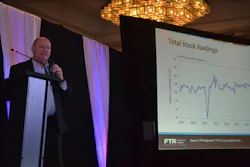
Contrary to the conventional wisdom of the past two or three years, the U.S. trucking industry hasn’t been mired in a “freight recession,” FTR Chairman Eric Starks suggested in opening his portion of the economic outlook and trailer forecast at the TTMA convention May 1.
Unfortunately for trailer OEMs, a change in terminology won’t improve equipment demand anytime soon.
FTR data shows that freight “by and large,” has been “fairly flat” since the economy came out of Covid, and there is not “a material dip” to indicate the so-called freight recession.
Instead, fleets—and trailer customers—have been stuck in a “rate recession.”
“This is not a demand recovery that we're looking at; what we're seeing is a supply side issue, and so that changes the dynamics of what's going on,” Starks said. “It has a great impact on rates, but it doesn't necessarily change the fundamentals.”
The challenge for FTR, as an industry forecaster, is that “there are so many things happening” that it’s a “struggle” to account for them all.
“How do you talk about USMCA, what's happening with the Fed? What's going on with Iran, cryptocurrency, Venezuela, ICE, Minnesota—all of these things? We can't just look at this stuff in one lens,” Starks continued. “We have a lot of things happening that deal with policy, that deal with politics, that deal with financials, that deal with social justice.
“We are in an environment that is radically different than where we have traditionally been.”
Macroeconomic headwinds
Before Starks started trying to explain how this complicated environment impacts the TTMA audience, Lindsay Bur opened the discussion by framing the broader economic environment.
Bur, director of data science and economics at the American Trucking Associations, characterized the broader economy as a "stagnant no hire, no fire" market. While the U.S. GDP has maintained a long-run historical average of approximately 2%, Bur warned that the underlying composition of that growth is problematic for freight.
Consumer spending has shifted significantly away from goods and toward services, largely because incoming tariffs have made physical goods more expensive.
"You can't put services on a truck," Bur noted, highlighting that while a consumer might choose a concert over a new dishwasher due to relative affordability, the dishwasher drives far more freight.
This shift is compounded by a high effective tariff rate, which has climbed to roughly 11% following various administrative actions. Furthermore, inflationary pressure remains a dominant theme.
“A lot of economists will talk about the inflation rate, and getting down closer to the Federal Reserve's target of 2%—but that's not what people feel when they go to the grocery store” Bur said. “They're not thinking about how prices have decelerated in their growth, they're just seeing that the price level has increased drastically since early prior to the pandemic in early 2020. We're seeing that the price level is up almost 30% since 2020 but when economists talk about inflation, they're like, ‘Wow, look how much it's come down.’”
The most volatile factor in Bur’s forecast was the war in Iran and its impact on energy prices. With diesel prices accelerating and uncertainty surrounding the Strait of Hormuz, Bur predicted that traffic would not return to normal levels until at least late 2026 or 2027, creating a persistent drag on the economy.
Bur emphasized that any recovery will likely be "supply-side," driven by carriers exiting the market rather than a sudden surge in consumer demand.
Indicators driving trailer demand
Starks described the current state as a "chaos environment," and this uncertainty is reflected in the U.S. trailer net orders, which have remained weak, down 15% year-over-year as of early 2026. Backlogs are also subdued, with visibility falling to approximately 5.5 months—a level Starks described as neither strong nor critically weak, but rather "status quo.”
Several key indicators are currently suppressing the demand for new trailers:
-
The trailer-to-tractor ratio: Public truckload carriers are currently holding an elevated ratio of nearly four trailers to every one tractor. Starks indicated that this ratio needs to correct, as it suggests an oversupply of trailers relative to the available power units.
-
The EPA 2027 pre-buy: Capital allocation is shifting away from trailers and toward Class 8 tractors. Because of the EPA 2027 NOx mandate, which is expected to add $10,000 to $30,000 to the cost of a new truck, fleets are prioritizing power unit replacements now to avoid future costs. Consequently, more trucks are being ordered than trailers, a reversal of the historical norm where trailer orders typically exceed truck orders by 5,000 units per month.
-
Average fleet age: Both tractors and trailers are aging. The average age of trailers at public carriers has reached 6.53 years, the highest since 2014. While this suggests a latent need for replacement, carriers currently lack the net income to fund these purchases.
-
Scrappage vs. production: Historically, trailer production rarely falls below scrappage levels. However, the industry is currently in a rare period where production is below the scrappage rate, an event typically seen only during severe recessions.
Sector outlook
Starks provided a breakdown of how these pressures are manifesting across different trailer segments:
-
Dry van: Production for 2026 is forecast at 181,000 units, a significant drop from the 240,000 units originally predicted a year ago. Recovery in this segment is not expected until 2027 as the pre-buy for tractors fades.
-
Reefers: This segment has seen production fall below economically derived demand, largely due to poor carrier profitability.
-
Flatbed: One of the few bright spots, the flatbed market is being bolstered by a boom in data center construction. While other private construction like warehouses has meandered, the massive spending on data centers is providing a localized lift for vocational trailers.
Navigating the trough
Starks concluded that 2026 will be a "down year" for the trailer industry, characterized by weak orders and capital shifting toward power units, meaning the industry must continue to navigate a period of high costs, regulatory confusion, and an oversupply of equipment.
“We have things picking up in Q1 of 2027 but the timing is unclear: So is it Q1 or is it Q2? I don't know, but we have that turn happening as we move into the first part of 2027,” he said. “What's crazy about this is that, with how long and extended this cycle has been, that it hasn't gotten worse, to be honest. It could have been significantly worse than what it has been.
“The industry, in general, does not like flat. We can deal with things growing, we can deal with things falling. Flat is difficult to manage through. Carriers hate it, and manufacturers then have to reap those repercussions.”
About the Author
 Kevin Jones
Kevin Jones
Editor
Kevin has served as editor-in-chief of Trailer/Body Builders magazine since 2017—just the third editor in the magazine’s 60 years. He is also editorial director for Endeavor Business Media’s Commercial Vehicle group, which includes FleetOwner, Bulk Transporter, Refrigerated Transporter, American Trucker, and Fleet Maintenance magazines and websites.
Working from Beaufort, S.C., Kevin has covered trucking and manufacturing for nearly 20 years. His writing and commentary about the trucking industry and, previously, business and government, has been recognized with numerous state, regional, and national journalism awards.