Key Highlights
- The Federal Excise Tax on trucks was introduced during World War I to fund military efforts and has remained largely unchanged for over a century.
- Industry groups have repeatedly lobbied for the repeal of FET, citing its outdated structure and negative impact on fleet modernization and environmental goals.
- Funding challenges for the Highway Trust Fund, combined with political resistance to raising fuel taxes, complicate efforts to replace FET with alternative revenue sources.
- Proposals include indexing the tax, spreading payments over vehicle ownership years, or shifting to vehicle miles traveled (VMT) taxes, though industry resistance persists.
- Despite ongoing legislative efforts, FET remains in place, with industry stakeholders emphasizing the need for a balanced, predictable funding approach to support infrastructure and technological progress.
The American Revolution was kickstarted by a founding principle of no taxation without representation. But 250 years later, there’s a tax on heavy-duty trucks and trailers that lives on despite the years of protest from fleets, manufacturers, and their representatives.
The United States of America was a spry 141 years old when the Doughboys became the first American soldiers to venture abroad. To help pay for General Pershing’s American Expeditionary Forces foray into World War I, Congress enacted the Federal Excise Tax on on-highway equipment.
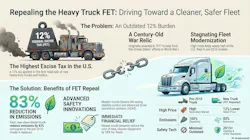
The war was over a little more than a year after the U.S. stepped in; FET is still with us more than a century later. And FET has risen from 3% to 12%—the highest such levy on the federal books.
That adds up to “real money” when you’re talking about modern, high-tech tractor-trailers—to say nothing of commercial EVs. The thing is, fleets who want the latest, most fuel efficient (and that means cleanest), safest, and cost effective equipment have to pay Uncle Sam for the privilege.
Laying out trucking’s legislative priorities for the upcoming highway bill last summer, ATA President and CEO Chris Spear pointed out that FET “dates back to the Titanic sinking.”
“It was to fund trench warfare in World War I. It's outdated. This was put in place by Congress, coupled with a number of other provisions that no longer exist—but ours do,” Spear testified before a Senate Commerce Transportation subcommittee. “It's a 12% tax on trucks and trailers, and that's about $35,000 for both. So, if you've got somebody out there that's buying, say, 1,800 new tractors, for a third of their fleet that they turn over every year, that's nearly $65 million. That's real money.
“That's going to the federal government, not to them. It's our money. We can invest it in training, pay, equipment. We can get that brand new equipment out there and replace the old stuff. You'll reduce emissions by 83% just by putting new diesels out on the road.”
Taxation despite representation
Indeed, the effort to repeal FET has been a biennial rite of spring since 2010 as pro-trucking members of Congress have worked up legislation, often with an eye on the next highway bill, also known as the surface transportation reauthorization package.
Support for repeal has been a legislative priority for manufacturers, dealers, and fleets for more than decade, with various association-organized visits to Congress, including a rally in front of the Capitol by the newly formed Modernize the Truck Fleet (MTF) coalition in 2019. Taking the lead were American Truck Dealers, the National Trailer Dealers Association, the National Tank Truck Carriers Association, NTEA — the Association for the Work Truck Industry, the Truck and Engine Manufacturers Association, and the Truck Renting and Leasing Association.
Result: No action on proposed legislation.
Then, in June 2020, the coalition and more than a hundred of its closest corporate and industry association supporters pleaded with Congress for relief during the chaotic pandemic months. A bill was introduced that called for a temporary halt on FET assessments–but the language didn’t make it into any of the COVID recovery packages.
Just two years later, the industry was still hoping against hope.
“FET repeal is something we've worked on for years and years. With the new technology that's coming out, vehicles will become more efficient but probably more expensive—which means more FET,” Mike Kastner, NTEA senior vice president, told TBB at Work Truck Week 2023. “That defeats the purpose of trying to get more fuel-efficient vehicles out there, and keeps people holding on to their old vehicles longer.
“There's a great bipartisan set of sponsors that I think provides the best opportunity we've ever seen.”
Yet, here we are—still.
A year ago, language proposed for the One Big Beautiful Bill Act would’ve reduced FET to 2% —but it didn’t make the final funding package.
The latest swing: HR 2424, of the Modern, Clean and Safe Trucks Act of 2025.
Spear, speaking with trucking editors at last fall’s ATA Management Conference and Exhibition, was hopeful about the newest effort. He suggested ATA would be more directly engaged in pursuing repeal, rather than leaning on various coalitions as the organization has done in the past.
“I think now we have a very good, grounded reason for asking for it in the next package that moves through Congress,” Spear said. “And, candidly, we need some relief for these motor carriers. If you're going to absorb the [Section] 232 [tariffs], if you absorb the [EPA] low-NOx rule, you can't keep adding costs onto the industry when it's not moving freight.”
Alas, while much of the sweeping ATA legislative agenda—infrastructure investment, truck parking, numerous workforce issues, electrical vehicle fees, autonomous vehicle standards, cargo theft prevention, CDL school requirements—is included in the initial draft of the highway bill, or the BUILD America 250 Act published in mid-May, FET repeal doesn’t get a mention in the 1,000-page piece of work from the House Transportation & Infrastructure Committee.
The funding problem
That the repeal of FET is so important to one of America’s critical industries should make it a no-brainer—and Congress should be fully qualified and capable of handling it.
Mike Joyce, lead lobbyist for the Truck Trailer Manufacturers Association and a policy strategist specializing in transportation and infrastructure, spelled out the snag: HTF.
“The Highway Trust Fund has not kept up with inflation. In fact, we haven't raised the fuel tax since 1993 Federal fuel taxes have not been raised since 1993—while postage stamps have gone up 19 times. So it’s hardly a surprise the HTF is no longer sufficient to fully fund surface transportation infrastructure,” Joyce said, speaking at last year’s TTMA convention. “And I will tell you, Congress has zero appetite on both sides of the aisle to raise fuel taxes—so that's going to be a problem when it comes into 2026 and passing a highway bill.”
Joyce put FET revenue at about $7 billion in 2023 and, even with FET, fuel taxes can’t keep up with recent spending. Proposed FET alternatives like indexing the fuel tax, annual registration fees, or vehicle miles traveled (VMT) taxes have been discussed, but VMT has faced resistance from the trucking industry.
It’s a dilemma. Just as the trucking industry came out in opposition to a gas tax pause during the Iran war, undercutting the long-term viability of HTF is a problem for highway transportation.
NTDA has been a leading advocate for FET repeal, but the effort is taking a backseat during the current Congress: The association is focusing its policy attention on resolving the federal tax code around trailer dealer floorplan assessments.
So FET remains a net positive source of federal revenue, as NTDA President Gwen Brown told TBB. Approximately 14% of Highway Trust Fund revenues are generated through the FET, while roughly 21% comes from the federal tax on diesel. However, Brown noted, during weaker commercial vehicle sales cycles, FET revenues can decline significantly.
“Given these fluctuations, it is appropriate to reevaluate how the FET is structured, collected, and applied,” Brown said. “The current requirement for a 12% tax payment upfront creates a significant barrier to purchasing decisions and can discourage both fleet managers and individual buyers from replacing vehicles when desired, instead delaying purchases until absolutely necessary.”
A more “balanced and predictable” approach should be considered—one that smooths FET revenue generation over time, similar to annual vehicle registration or license plate fees, Brown proposed.
Another option would be to allow the tax burden to be distributed over “the first four or five years” of vehicle ownership, reducing the upfront financial impact while still preserving a consistent revenue stream for the Highway Trust Fund.
“Unfortunately, issues surrounding highway infrastructure, the FET, and transportation funding often fail to capture significant political attention, making it unlikely that a comprehensive reauthorization bill will pass in 2026,” Brown said.
But National Tank Truck Carriers isn’t backing off. The association has included FET repeal among its Tier 1 regulatory and legislative priorities for 2026. After all, a fancy, new tank trailer can run $150,000 and more.
“If you love chaos, you love what's going on in Washington, DC, right now. It is exceptionally tense,” said NTTC lobbyist Britton Clarke Mullen, speaking at the 2026 NTTC Annual Conference in April. “The challenge that we continue to face as an industry, with leadership in Congress, is that y’all have got to find a way to replace this tax. As an industry, we have to come together and figure out a viable solution. And that's not just tank truckers, that's TCA, ATA—all of us together as an industry—and right now, we have not been successful to find that one viable solution that we can get behind.
“Don't kill the messenger but, unfortunately, I don't see a path forward right now for repealing the Federal Excise Tax. However, we will continue to talk about it and hopefully have action sooner rather than later.”
Coda: FET lives on
As this issue of Fleet Maintenance goes to press, the only action on the Modern, Clean and Safe Trucks Act of 2025 since its introduction occurred in April, when Rep. Darin LaHood (R-Ill.) became the lead sponsor of H.R. 2424, the bill originally introduced by Rep. Doug LaMalfa (R-Calif.). While LaHood has been a leading co-sponsor through several tries, LaMalfa was essentially the father of FET repeal.
LaMalfa died in January while undergoing emergency surgery for an aortic aneurysm. Without its champion—and more importantly, a feasible alternative for HTF funding—the FET is likely to outlive us all.
About the Author
 Kevin Jones
Kevin Jones
Editor
Kevin has served as editor-in-chief of Trailer/Body Builders magazine since 2017—just the third editor in the magazine’s 60 years. He is also editorial director for Endeavor Business Media’s Commercial Vehicle group, which includes FleetOwner, Bulk Transporter, Refrigerated Transporter, American Trucker, and Fleet Maintenance magazines and websites.
Working from Beaufort, S.C., Kevin has covered trucking and manufacturing for nearly 20 years. His writing and commentary about the trucking industry and, previously, business and government, has been recognized with numerous state, regional, and national journalism awards.