Playing out of a 'divot': aftermarket outlook
Key Highlights
- The industry is entering 2026 with heightened uncertainty due to unresolved political, judicial, and monetary policy risks.
- Nominal market values are rising, but real volume growth remains minimal, driven primarily by increasing vehicle populations rather than higher demand.
- Fleet utilization rates are low, prompting fleets to adopt cost-saving measures such as delaying equipment purchases and shifting toward value-line parts.
- Distributors face margin erosion and tariff pass-through challenges, with most passing costs to customers to stay afloat amid supply chain pressures.
- Monetary policy is expected to remain stable during leadership transitions, but political uncertainties could influence market conditions in early 2026.
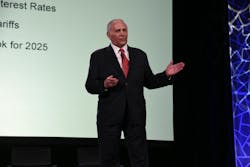
The heavy-duty aftermarket is moving into a period of heightened uncertainty as it transitions from a turbulent 2025 into a 2026 that experts warn will be "very challenging". During the recent Heavy Duty Aftermarket Dialogue (HDAD), Dr. Bob Dieli, economist and proprietor of MacKay & Company’s economic reports, and Dave Kalvelage, senior market analyst at MacKay & Company, provided a data-driven analysis of the 2025 "freight recession" and a sobering forecast for the year ahead.
Their collective analysis suggests that while nominal market values are rising, the industry is grappling with "recession eligibility," tariff-driven price volatility, and a fundamental shift in fleet purchasing behavior.
“We have to make plans under conditions of uncertainty, some of which are likely to be resolved because they do not involve directly economic conditions, rather political and judicial conditions; we simply have to wait for those decisions to be announced,” Dieli explained. “The major policy risks are the same. Tariffs and monetary policy which are very much unsettled and could come out in any number of ways that are almost impossible to predict. 2025 was challenging; 2026 is going to be very challenging. But you folks are resilient. You know how to do this. This is not your first rodeo.”
The macro perspective: recession eligibility, ‘sideways’ economy
Dieli’s assessment of the 2026 landscape begins with a warning: the U.S. economy remains "recession eligible.”
Using his proprietary Enhanced Aggregate Spread (EAS), Dieli pointed out for three years the economy has been characterized by instability and a Federal Reserve in a "bad mood.” The EAS currently sits in what Dieli calls a "divot"—a level below the 200-basis-point mark that has preceded every recession since 1955.
The primary metric for the trucking industry, Truckable Economic Activity (TEA), saw a unique trajectory in 2025. After starting the year at 4% growth, it experienced a "trip through six" percent before settling at 2.3%. This surge was not driven by organic demand but by a massive influx of imports and inventories as businesses rushed to beat impending tariffs. For 2026, Dieli expects TEA to continue moving "sideways" at a growth rate of approximately 2.3%.
Dieli emphasized that 2026 will be defined by three "unsettled" risks that are unlikely to be resolved before mid-year: the Supreme Court ruling on tariff legality, the mandatory USMCA review on July 1st, and the confirmation of a new Federal Reserve chair. Until these political and judicial milestones are met, business capital expenditure (capex) will likely remain restrained by uncertainty.
Aftermarket forecast: growth driven by population, not volume
Dave Kalvelage’s outlook for the aftermarket provides a more granular view of the industry’s financial health.
In 2025, the U.S. heavy-duty aftermarket reached $54.4 billion, a 5.5% increase over the previous year. However, Kalvelage noted that this was largely "phantom" growth; approximately 4% of that increase was attributed to pricing inflation, leaving real volume growth at a meager 1.5%.
“FTR's Class 8 utilization has been flat for two years and their current forecast is also continuing to be flat,” Kalvelage said. “FTR's trailer utilization was down in 2025 but they're also expecting improved conditions for 2026, and we just talked about operating populations. So a lot of mixed signals. We're still monitoring a lot of the economic variables and all these signals that out there.”
For 2026, MacKay & Company forecasts a total North American aftermarket value (hard parts only) of approximately $69 billion. The U.S. market is expected to grow by 3.9%, while Canada and Mexico are projected to see increases of 3.5% and 6.2%, respectively. Crucially, with pricing expected to stabilize at a more historical 2.5%, the "real" volume growth for 2026 will remain minimal, likely around 1%.
The primary engine for this growth is not increased vehicle activity but the growing vehicle operating population. Despite a sharp decline in retail sales for Class 6-8 trucks and trailers in 2025—which saw drops of 11% to 13% in the U.S. and even steeper declines in Mexico—the total number of trucks on the road continues to rise. This expanding "installed base" provides a natural floor for parts demand, even as individual truck utilization fluctuates.
Fleet realities: low utilization, shift to value lines
The "freight recession" is perhaps most visible in fleet utilization rates. Kalvelage reported that Class 6-8 truck utilization ended 2025 at 84%, slightly below the long-term average. More concerning is the trailer utilization rate, which plummeted to 83% in the fourth quarter of 2025. Fleet managers are pessimistic about the start of 2026, forecasting further drops in activity.
This environment of low freight rates and high operating costs has forced fleets into survival mode. Surveys conducted by MacKay & Company reveal that fleets are adopting defensive strategies, including:
- Delaying major equipment purchases to preserve cash.
- Extending service intervals and delaying "cosmetic" repairs.
- In-sourcing repairs rather than using outside service providers.
A significant trend emerging in 2026 is the migration toward non-OE or "value-line" parts. While genuine parts still command about two-thirds of the market, 21% of fleets admit that tariff-related price hikes have driven them to purchase more non-genuine components. On average, fleets are looking for a 32% cost savings before they are willing to switch brands.
Distributor struggle: margin erosion, tariff pass-through
Distributors and dealers are caught between rising supplier costs and cash-strapped customers. Their top concerns for 2026 include parts availability, labor issues, and margin erosion. The impact of tariffs has been particularly disruptive; while only 19% of distributors have changed suppliers due to tariffs, the financial pressure is widespread.
The data shows a divide in how distributors manage these costs. Two-thirds of distributors are passing the full cost of tariffs through to their fleet customers, while the remaining third are absorbing some or all of the impact to remain competitive. On average, about three-quarters of the total tariff cost is being passed down the supply chain.
Distributors are now calling on manufacturers to "keep a lid on prices" and improve lead times to help them navigate the lean months of 2026.
On the plus side, even under pressure, only 19% of the dealers and distributors surveyed by MacKay said they've changed suppliers, meaning 4 in 5 are standing pat and sticking with their current suppliers.
Monetary policy and the 'pause and pivot'
As the industry looks for relief from high interest rates, Dieli offered a cautionary note regarding the Federal Reserve. While there is much speculation about how a new Fed chair might change direction, Dieli argued that institutional inertia usually prevails. Historically, the track of the Fed funds rate does not change direction simply because the leadership changes; policy tends to stay consistent during transition periods.
Dieli reminded the audience that the Fed operates by a "majority vote" of 12 members, meaning a new chair represents only one vote. He expects the Fed to continue its "pause and pivot" strategy, and he cautioned that a contentious confirmation process for the next chair could add another layer of market uncertainty in early 2026.
“There will be a great deal of talk about how if we get a new Fed chair, we're going to get some change in monetary policies,” Dieli said. “We might eventually, but during the transition period, especially when the new chair takes over, what had been the policy is likely to stay the policy. Rates are already coming down. And the idea that someone that Mr. Trump might appoint will make a difference to this in the short run is not the case.”
Conclusion: Preparing for a ‘very challenging’ year
The 2026 outlook for the heavy-duty aftermarket is a study in resilience. While the macro-economic indicators suggest "more of the same" sideways growth, the operational reality for fleets and distributors is one of intense pressure. The industry is essentially waiting for the "political and judicial conditions" regarding tariffs and trade treaties to be resolved mid-year.
“How can dealers and distributors assist fleets in 2026?” Kalvelage said, again pointing tp the survey. “Notice the common theme here: Again, we've got reducing prices, parts availability, improving customer service. So make sure you're on top of your customer service with fleets.”
Dieli’s closing sentiment summarized the industry's mood: most stakeholders want things to "remain the same but get better," but the reality is that things will simply be "different.” Success in 2026 will not come from market-wide tailwinds but from the ability of individual businesses to manage costs, maintain customer service, and adapt to a structural shift where price transparency and parts availability are the ultimate competitive advantages.
For those who can weather the "divot" of 2026, the long-term growth of the vehicle population offers a light at the end of the tunnel.
About the Author
 Kevin Jones
Kevin Jones
Editor
Kevin has served as editor-in-chief of Trailer/Body Builders magazine since 2017—just the third editor in the magazine’s 60 years. He is also editorial director for Endeavor Business Media’s Commercial Vehicle group, which includes FleetOwner, Bulk Transporter, Refrigerated Transporter, American Trucker, and Fleet Maintenance magazines and websites.
Working from Beaufort, S.C., Kevin has covered trucking and manufacturing for nearly 20 years. His writing and commentary about the trucking industry and, previously, business and government, has been recognized with numerous state, regional, and national journalism awards.