Trailer trade war: unfair competition or a tough downcycle?
Key Highlights
- U.S. trailer manufacturers allege that foreign imports are dumped and subsidized, causing significant harm to domestic industry and leading to a 'pricing death spiral.'
- The coalition highlights the 'inventory overhang' and structural disadvantages, such as high start-up costs for fabrication, which foreign imports exploit by shipping subassemblies as kits.
- Respondents counter that the industry is suffering from macroeconomic issues like the freight recession, labor shortages, and supply chain disruptions, not unfair trade practices.
- The dispute involves complex legal thresholds, including the negligibility rule, and questions whether Canadian imports assembled from Chinese kits should be classified as Chinese or Canadian.
- Foreign government programs and subsidies, such as Mexico’s IMMEX and China’s state-owned enterprises, are seen as unfair advantages that distort the market and threaten U.S. manufacturing.
Is the trailer import trade wind a fair breeze, or is it a growing storm that U.S. companies need to be sheltered from?
A group made up of three of the top five U.S. trailer manufacturers is challenging imported van and reefer trailers priced and sold unfairly in the domestic market, targeting other OEMs in the Top 10 in the 2024 TBB Trailer Output Report. Both the petitioners and trailer importers presented their cases during a preliminary conference on the matter before the U.S. International Trade Commission on December 11.
The American Trailer Manufacturers Coalition (ATMC), representing U.S. producers including Great Dane LLC, Stoughton Trailers LLC, and Wabash National Corporation, filed comprehensive antidumping (AD) and countervailing duty (CVD) petitions with the ITC on November 20, targeting van-type trailers and their subassemblies from Canada, Mexico, and the People’s Republic of China.
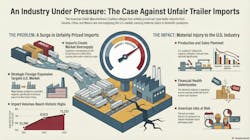
The coalition alleges that these dumped and subsidized imports have caused and threaten to cause material injury to the U.S. domestic industry, which produces the trailers considered the "lifeblood of American freight,” according to the petition.
The respondents—including Hyundai Translead, Utility Trailer Mfg., and Vanguard—contend that the domestic industry is ignoring the macroeconomics of the "Great Freight Recession" to justify protectionist measures.
A ‘pricing death spiral’
The ATMC presented a stark account of an industry under siege, describing the enclosed trailer as the "lifeblood of American freight.”
Chris Hammond, executive vice president of sales for Great Dane, testified that while his company has survived for 125 years, peers like Dorsey Trailer stopped building vans and reefers, and others such as Lufkin, Trailmobile and HPA Monon have been forced to exit the market. He noted that since 2004, foreign competitors like Hyundai Translead and CIMC/Vanguard have grown from a 7% market share to nearly 40% by 2023, primarily by undercutting domestic prices.
“This places enormous pressure on U.S. producers like Great Dane that do not have access to subsidized raw materials or other subsidies,” Hammond said. “We are left with the untenable decision to either lower our prices or lose sales.”
Stoughton Trailer President and CEO Bob Wahlin likewise pointed to the harm to domestic trailer manufacturing since CIMC and Hyundai Translead entered the market, with the number of “significant” U.S. van manufacturers shrinking from 20 to just 7.
“Subject imports changed the van-type trailer manufacturing landscape in this country,” Wahlin testified. “It quickly became clear that foreign producers were using a different playbook than the rest of us—a playbook not constrained by fair dealing and market principles.”
Indeed, unfairly priced imports surged so aggressively in 2022 and 2023 that customers essentially "stopped buying" domestic units. Wahlin warned of a "pricing death spiral," where domestic producers are forced to take on unprofitable business just to keep their sophisticated plants running and retain their workforce.
Donald Winston, SVP and COO of Wabash, added that his team frequently reports lost sales where import pricing is "10, 20 even 30% lower" than domestic products, a gap that internal efficiencies cannot bridge.
“My job is to lower our costs as much as possible to give our commercial team a shot at these sales,” Winston said. “This is an uphill battle when our foreign competitors’ prices can even undercut our costs of production. We have made our production processes even more efficient, increased productivity, and streamlined our raw material sourcing, but we’re still getting injured by low-cost imports.”
A central pillar of the coalition's argument is the "inventory overhang".
Dr. Seth Kaplan of International Economic Research (IER) described the market saturation of 2022-2023 as a choice between "murder or manslaughter," arguing that imports entered far in excess of actual demand, creating a massive glut that "cratered" new orders in 2024 and 2025.
“At the high point, [domestic manufacturers] didn't do as well as they should have done,” Kaplan concluded. “And now, as it's turned down a bit, they're doing worse than they should be doing. I think the imports in the context of these demand changes are a key source of the damage we've seen.”
The ‘job shop effect’
Beyond simple volume, the coalition highlighted a structural disadvantage in the capital intensity of trailer production.
Trailer production involves three stages: fabrication, assembly, and finishing, explained Bill Davidson, Great Dane’s VP of manufacturing. Fabrication of key trailer components and subassemblies is the most intensive aspect, requiring sophisticated and expensive equipment. Davidson put the start-up cost for a new fabrication facility at roughly $150 million, versus only $20-$30 million for an assembly operation.
The coalition alleges that foreign producers, particularly from China, exploit this by fabricating subassemblies in subsidized, non-market environments and shipping them as "kits" for final assembly in the U.S. or Canada.
Carlos A. De Leon, president of Transport Solutions at Stoughton, confirmed the huge investment needed for a new fabrication facility, and testified that imported subassemblies negate the competitive advantage of domestic vertical integration. This has led to a "job shop effect," where U.S. factories—designed for high-volume, long-run production of standard 53-foot trailers—are pushed into small-volume, "niche" specialty markets that are inherently less efficient and more costly.
“That [niche trailer manufacturing] is not a safe place to hide because [subject imports] are moving into that as well,” Stoughton’s Wahlin said during the panel Q&A segment. “They started with that standard production, executed a plan and strategy where they dominate that, and now they're moving into everything else as they squeeze us out of the market.”
Not so fast: It’s the market
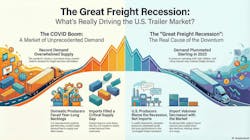
In a sharp rebuttal, the respondents argued that the domestic industry's woes are the result of a macroeconomic correction. The U.S. freight industry has been "mired in an unprecedented downturn" involving 13 straight quarters of soft demand, high costs, and low rates—a period the industry refers to as the "Great Freight Recession.”
“The simplistic narrative presented by the petition—one in which the allegedly low-priced imports subject to this proceeding have caused U.S. producers’ sales to decline and have negatively impacted the domestic industry’s profitability—bears no resemblance to the actual U.S. trailer market and overlooks the realities of our industry,” Hyundai Translead CEO Sean Kenney testified.
The COVID-19 pandemic created an artificial boom as home-bound consumers shifted spending to goods. During the 2022-2023 peak, domestic trailer producers could not satisfy demand due to labor and supply chain shortages. Foreign trailers were "drawn into the market" to fill a vacuum that U.S. manufacturers admitted they could not fill at the time.
Kenney also rejected the claims that imports exceeded demand, because that’s not the way the business works: “We produce and sell in response to specific customer orders, and while our dealer customers may maintain some inventories, they do not stockpile large inventories of trailers, if only because of their size.”
Furthermore, respondents challenged the ATMC’s credibility by citing their own public statements. They pointed out that while coalition leaders blamed imports during the ITC hearing, their annual reports, press releases, and media interviews attributed plant layoffs and declining profits to the prolonged freight recession. Subsequent respondent filings detailed these, citing dozens of such reports.
Respondents also dismissed the "inventory overhang" theory as a marketing illusion.
Mike King of King Country Trailer explained that online advertisements showing "thousands" of trailers often list the same unit multiple times with different cooling options, grossly inflating the perceived stock. Hyundai’s Kenney "categorically disagreed" with the notion of a massive glut, stating that dealer stock was "cleaned up very quickly" once demand normalized.
Some components imported
Denny Williams, COO at Vanguard Global Trailer Holdings, defended the operations of Vanguard Refrigerated Trailer and the Vanguard dry-van division. “About half” of the components used to build the reefer units are imported from China through a CIMC affiliate. The Vanguard Reefer Canadian division imports subassemblies from China and purchases components from Canadian and U.S. On the Vanguard dry-van side, only about 15% of the components are imported to its U.S. manufacturing sites.
“This freight recession has nothing to do with competition between domestic and imported trailers, or even between trailer producers generally,” Williams testified. “It is simply the result of an extraordinarily turbulent market that experienced swings in downstream purchasing and demand habits; labor and supply shortages, including through the freight industry and all the way down to parts and inputs; inflation; and rising interest rates.”
The international panel emphasized that price is not the sole determinant of a sale. For a large capital good with a 15-to-20-year lifespan, factors like thermal efficiency, durability, and after-sales support are paramount. Hyundai also noted its geographical advantage on the West Coast, where delivering a trailer from Midwestern domestic plants can add significant costs giving Western U.S. customers a natural incentive to source from Mexico.
Similarly, Steven Bennett, president and COO of Utility trailer, emphasized that the company’s Mexico facility “supplements U.S. production capacity by providing access to labor that is unavailable domestically and offering more attractive shipping opportunities for geographical areas that otherwise would be harder to reach.”
Additionally, the Utility Mexico facility’s “single largest supplier” is U.S.-based Western Extrusion, whose president also testified on the panel.
Canadian ‘negligibility’ challenge
A significant portion of the follow-up filings from the Government of Canada and Manac focused on the legal threshold of negligibility. Under U.S. law, if imports from a country account for less than three percent of total imports, the investigation must be terminated.
The Canadian respondents argued that their imports fall well below this mark.
A key dispute arose regarding Vanguard Refrigerated in Canada. The coalition argued that trailers assembled in Canada using Chinese-made kits should be treated as Canadian imports for the sake of the negligibility analysis. Conversely, respondents argued that if the scope defines a Chinese subassembly as "Chinese" regardless of third-country processing, then these units must be reclassified as Chinese imports, which would drop the remaining Canadian import volume into negligible territory.
Loopholes, global subsidies
The coalition countered the "freight recession" narrative by pointing to foreign government programs that tilt the playing field.
The U.S. producers highlighted Mexico’s IMMEX program, which allows manufacturers to import world-priced steel from countries like China and Korea duty-free, process it into trailers, and ship the finished product to the U.S. These programs act as a "back door" to avoid the very duties meant to protect U.S. steel and aluminum producers.
The coalition also cited CIMC's role as a strategic state-owned enterprise (SOE), operating as the "point of the spear" for China’s export-driven economic strategy. They argued that these entities do not operate on a profit-maximizing basis but instead seek to maintain capacity utilization at any cost, essentially "exporting their way" out of China's internal economic challenges.
Workforce in jeopardy
The human cost of this trade war was a recurring theme, with both Wabash and Great Dane reducing employee headcounts.
Respondents argued these layoffs are simply a "right-sizing" in response to the end of the post-pandemic buying binge and have nothing to do with unfair trade. They noted that domestic producers are already heavily protected by existing Section 301 and Section 232 duties, including a 50 percent duty on the steel and aluminum content of Mexican trailers implemented in August 2025.
Conclusion: Two versions of one market
The ITC now faces a fundamental choice between two interpretations of the same data. To the petitioners, the market is a victim of an intentional, subsidized surge of foreign trailers that has created an unsustainable oversupply and a permanent downward shift in domestic pricing. To the respondents, the industry is simply navigating a cyclical but prolonged downturn after an unprecedented pandemic boom.
The final determination will decide whether the U.S. van-type trailer industry receives the trade shield it claims is necessary for survival, or whether the current slump is viewed as a macroeconomic headwind that every manufacturer, domestic and foreign, must simply weather together.
The commissioners were scheduled to vote on Jan. 2 and report the determinations to the Secretary of the Dept. of Commerce on Jan. 5. The commissioner's opinions are to be issued on Jan. 12, after this edition of TBB has gone to press. Look for a report on the findings on TrailerBodyBuilders.com.
About the Author
 Kevin Jones
Kevin Jones
Editor
Kevin has served as editor-in-chief of Trailer/Body Builders magazine since 2017—just the third editor in the magazine’s 60 years. He is also editorial director for Endeavor Business Media’s Commercial Vehicle group, which includes FleetOwner, Bulk Transporter, Refrigerated Transporter, American Trucker, and Fleet Maintenance magazines and websites.
Working from Beaufort, S.C., Kevin has covered trucking and manufacturing for nearly 20 years. His writing and commentary about the trucking industry and, previously, business and government, has been recognized with numerous state, regional, and national journalism awards.