Pent-up demand has 'flipped the switch' on trailer orders: October reports
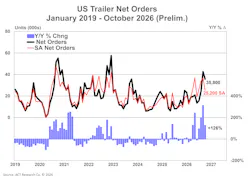
The 2027 U.S. heavy-duty trailer ordering season maintained robust momentum through October 2026, building upon September's historic intake. Both FTR Transportation Intelligence and ACT Research report that net trailer orders comfortably exceeded 35,000 units for the month.
Although order intake saw a moderate sequential pullback following September's near-peak levels, massive year-over-year gains reaffirm a decisive market recovery driven by pent-up replacement demand and fleet urgency.
“Expectations of further equipment price increases may be accelerating fleet purchases. Uncertainty surrounding the EPA’s 2027 NOx regulations and Class 8 truck pricing could be shifting some near-term capital spending toward trailers,” said Dan Moyer, FTR senior analyst, commercial vehicles. “Improving capital spending intentions, heightened purchasing urgency, increased quoting activity, strong leasing utilization, and tighter equipment availability further support the outlook.
According to preliminary data from ACT Research, October net trailer orders reached 35,800 units, marking a 126% year-over-year surge (an increase of nearly 20,000 units compared to October 2025). While nominal volume contracted 16% (down 6,900 units) from September's high intake—yielding a seasonally adjusted (SA) figure of 25,200 units—analysts emphasize that the dip is not downward market indicator given September’s extraordinary surge.
“Seasonally speaking, October net orders should have improved sequentially, so the dip from September was somewhat surprising,” said Jennifer McNealy, director CV market research and publications at ACT Research. “On the other hand, September’s order intake was exceptionally high enough that the downward-pointing data, albeit unexpected, is not worrisome. This simply continues the unusual pattern of the 2025-2026 order cycle.”
Data from FTR Transportation Intelligence reflected matching strength, recording October net orders at 38,385 units. Although down 11% month-over-month from September’s 43,059 units (which marked the highest monthly total since December 2022), October output represented a 142% year-over-year increase. FTR notes that sustained order velocity since August confirms the release of substantial pent-up replacement demand across carrier fleets.
Core drivers: tariffs, regs, and fleet profitability
Industry analysts point to a confluence of operational and economic catalysts behind the autumn order surge.
“The current US trailer industry environment is a perfect storm,” McNealy said. “Carriers now have both the willingness and the ability to purchase equipment, and are inspired to do so sooner rather than later, as they also face rising prices and an untested domestic supply chain that could cause build constraints, lengthier production queues, and delayed deliveries.
“We often make the case that there is a profitability-related component that makes demand somewhat binary. It would appear that the switch has been flipped.”
Primary demand drivers identified across both reports include:
- Tariff pre-buying and price escalation: Fleets are moving aggressively to lock in orders ahead of anticipated equipment price increases, trade policy actions, and potential domestic supply chain constraints.
- Regulatory and capital realignment: FTR Senior Analyst Dan Moyer highlighted that uncertainty surrounding the EPA’s 2027 NOx regulations and elevated Class 8 truck pricing may be shifting near-term fleet capital expenditures directly toward trailer procurement.
- Pent-up replacement and freight recovery: Years of deferred fleet upgrades, combined with improving carrier profitability, healthier freight fundamentals, and a sharply tighter driver supply, have effectively "flipped the switch" on fleet purchasing.
Production queues and expanding backlogs
As net orders consistently outpaced monthly factory build rates, industry backlogs expanded substantially. ACT Research reported that the total U.S. trailer backlog grew by approximately 16,800 units to finish October at 129,756 units.
Order commitments remain exceptionally stable, supported by an industry cancellation rate of just 0.7% of backlog. As a result, the industry's backlog-to-build ratio stretched to 7.4 months, securing OEM production schedules well into mid-2027.
Looking ahead, while rising equipment costs, trade uncertainties, supply chain constraints, and lingering fleet financial pressures remain potential headwinds, the 2027 order season has established its strongest opening foundation in years.
About the Author
 Kevin Jones
Editor
Kevin has served as editor-in-chief of Trailer/Body Builders magazine since 2017—just the third editor in the magazine’s 60 years. He is also editorial director for Endeavor Business Media’s Commercial Vehicle group, which includes FleetOwner, Bulk Transporter, Refrigerated Transporter, American Trucker, and Fleet Maintenance magazines and websites.
Working from Beaufort, S.C., Kevin has covered trucking and manufacturing for nearly 20 years. His writing and commentary about the trucking industry and, previously, business and government, has been recognized with numerous state, regional, and national journalism awards.