Wabash sales slip 20% in Q1 amid 'uncertain' markets
Key Highlights
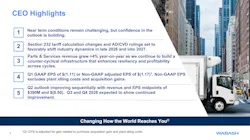
- Wabash reported a 20.4% decline in revenue for Q1 2026, primarily due to lower shipment volumes and industry cyclicality.
- The order backlog increased 19% sequentially to $837 million, indicating cautious but improving customer demand for future equipment needs.
- Management expects sequential quarterly improvements and benefits from recent trade policy changes to support a recovery in late 2026 and beyond.
- Strategic investments include expanding Parts & Services, acquiring Linq Venture Holdings, and launching AI-driven customer tools to enhance growth and efficiency.
- Wabash remains focused on rightsizing operations, domestic capacity expansion, and digital innovation to emerge stronger from the current downturn.
Wabash reported first-quarter 2026 financial results that reflected a "painful trough" in the highly cyclical transportation equipment market, characterized by cautious customer behavior and uncertain freight dynamics.
While the company missed analyst estimates on both revenue and earnings, management expressed a growing confidence that the first quarter represented the low point for the year, with a recovery path taking shape through sequential quarterly improvements and significant trade policy tailwinds expected in late 2026.
As we entered the first quarter, we did so with a clear-eyed view of the environment in front of us, Wabash President and CEO Brent Yeagy said. “Freight markets were uncertain, and customers continued to act cautiously. Order patterns were uneven, asset utilization inconsistent, and capital decisions across the industry were being evaluated carefully.
“Now as we move into 2026, both our customers and our visibility continue to improve, and it shows an environment that is building to set up for a constructive 2027 as spot rates, contract rates, capacity, and demand all are coming together to drive back to replacement demand for equipment, and possibly beyond as fleets begin to plan more confidently. “
Lower volumes pressure margins
For the quarter ended March 31, Wabash reported consolidated revenue of $303.2 million, a 20.4% decrease compared to the $380.9 million generated in the same period of the previous year. This decline was primarily driven by lower shipment volumes in the Transportation Solutions segment, which saw sales fall 27.9% year-over-year to $250.2 million. New trailer shipments totaled 5,378 units, down 14.5% from the prior year, while new truck body shipments plummeted 49.1% to 1,527 units.
The lower production volumes created operational inefficiencies and overhead pressures, leading to a consolidated GAAP gross margin loss of $11 million, or negative 3.5% of sales. On a GAAP basis, the company reported an operating loss of $52 million and a diluted loss per share of 6 million in purchase accounting gains related to the Linq Venture Holdings acquisition and $2.8 million in facility idling costs, the non-GAAP adjusted operating loss was $55.5 million.
Trucking market: cautious fleets
The primary headwind for Wabash remains the broader freight recession and its impact on carrier capital expenditures.
Despite these near-term challenges, management identified several underlying indicators of a pending recovery. Capacity in the trucking market is continuing to contract, which is beginning to improve freight rates and carrier profitability. Furthermore, the ATA for-hire truck tonnage index saw its largest year-over-year increase since late 2022, and the Logistics Managers Index showed the fastest expansion in nearly four years.
These fundamental shifts are beginning to manifest in Wabash’s order backlog, which grew 19% sequentially to $837 million. This increase, which management called a "historic high rate of growth" for a first quarter, suggests that while carriers remain conservative, they are increasingly engaging in conversations about their 2027 needs.
The company expects the truck body segment to remain soft through 2026, trailing the dry van recovery by approximately six to nine months as it relies more heavily on consumer discretionary spending and housing starts.
Trade policy and tariffs: A level playing field?
A central pillar of Wabash’s optimistic outlook for late 2026 and 2027 is a shifting trade landscape.
The domestic trailer industry has long contended with what Wabash characterizes as "unfairly traded imports" that threaten the stability of U.S. manufacturing. However, recent changes to Section 232 tariff calculations and pending antidumping and countervailing duty (AD/CVD) rulings are expected to provide "meaningful relief" for domestic producers.
Management anticipates these trade developments will favorably shift industry dynamics by leveling the playing field against foreign competitors who benefit from home-country subsidization. As these measures take effect, Wabash expects to benefit from greater pricing stability and an enhanced ability to gain market share.
The company is particularly well-positioned to capitalize on this shift due to its significant U.S. manufacturing footprint, including the Lafayette South plant, which provides the capacity to produce approximately 10,000 additional trailers annually compared to previous upcycles.
“I am very proud of our people on the manufacturing floor,” Yeagy said, “and I am eager to have them show what they are truly capable of when they rise to meet the challenges and the opportunities contained within the acceleration of demand at the start of a new industry period of expansion.”
Strategic initiatives
To counter the inherent cyclicality of the trailer market, Wabash is aggressively expanding its Parts & Services segment and digital ecosystem. Parts & Services generated $54.1 million in revenue during Q1, a 4.1% year-over-year increase, providing a counter-cyclical buffer to the decline in new equipment sales.
Strategic milestones in the quarter included:
- Linq Venture Holdings Acquisition: Wabash acquired the remaining 51% interest in this digital marketplace entity to enhance its "Trailers as a Service" (TaaS) initiative and recurring revenue streams.
- Upfit Center Expansion: The company is progressing with new upfit sites in Chicago, Atlanta, and Phoenix. At peak utilization, these sites are expected to generate $10 million to $20 million in incremental revenue each, with gross margins approaching 20%.
- Digital/AI Integration: The company launched SPEC SYNC and PartsPulse, AI-driven tools developed with UP.Labs to reduce friction in the quoting process and elevate the customer experience.
2026 outlook
Wabash ended the first quarter with total liquidity of $165.1 million, including $43.4 million in cash.
Looking forward, Wabash provided sequential growth guidance for the second quarter, with revenue expected between $380 million and $400 million. The company maintains its expectation for positive adjusted EBITDA in the second half of 2026 as shipment volumes ramp and operational efficiencies return.
While Wabash National’s first-quarter results highlight the severity of the current market downturn, the company’s strategic narrative is one of preparedness and resilience. By rightsizing its cost structure through facility idling while simultaneously investing in digital solutions and domestic capacity, Wabash aims to emerge from this cycle as a more diversified "solution provider" rather than a mere equipment manufacturer.
With a growing backlog and the protective umbrella of new trade policies on the horizon, Wabash is positioning itself to capture significant value when replacement demand returns in force in 2027.
About the Author
 Kevin Jones
Kevin Jones
Editor
Kevin has served as editor-in-chief of Trailer/Body Builders magazine since 2017—just the third editor in the magazine’s 60 years. He is also editorial director for Endeavor Business Media’s Commercial Vehicle group, which includes FleetOwner, Bulk Transporter, Refrigerated Transporter, American Trucker, and Fleet Maintenance magazines and websites.
Working from Beaufort, S.C., Kevin has covered trucking and manufacturing for nearly 20 years. His writing and commentary about the trucking industry and, previously, business and government, has been recognized with numerous state, regional, and national journalism awards.