Daimler Trucks unites chassis, school bus units
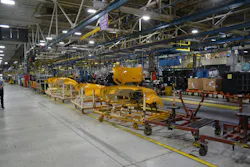
GAFFNEY, South Carolina—Just more than a year after forming a new division to drive efficiencies and accelerate innovation at Thomas Built Buses (TBB) and Freightliner Custom Chassis Corporation (FCCC), the leadership at Daimler Trucks Specialty Vehicles (DTSV) invited industry editors to tour the facilities here and learn about the opportunities already underway, thanks to the new organizational structure.
“At the end of the day, it's all about the strategy for the long term,” said Jeff Allen, senior vice president, operations and specialty vehicles, Daimler Truck North America. “How do we operate as one unit? How do we create value for our customers? How do we respond quickly? How do we deliver the highest quality product operating as one team?”
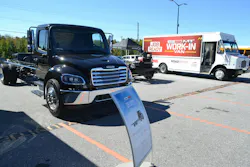
The most obvious measure: DTSV claims a 45% market share in the Class 5 through Class 7 market, including top position in the wide range of vehicles serving the school bus market, and a 70% RV market share in the combined Type A diesel pusher chassis and the growing Super C segments, explained T.J. Reed, DTSV president and CEO. And, he added, DTSV became the market-share leader in walk-in vans this summer.
“The mix of specialization and scale is a significant competitive advantage for us, and you can see it in our in our market position,” Reed said. “We're very proud to say, we are market leaders in the main segments that we participate in, and by far we have the broadest product portfolio in the sectors that we play in. We offer gasoline, engine, diesel, battery-electric.”
A key driver is the strategic decision to combine what had been three distinct engineering groups into a shared “engineering technical powerhouse” to add capability and capacity to new product development, Reed added.
“What's unique about our business? Everything we build has a body. We don't build tractors here, so that has a unique set of requirements,” Reed said. “You have to have the mechanical and the electrical interface, not only to mount the body, but also the vehicle has to be operating as an integrated unit.”
Vice President of Engineering Kenda Eads oversees the unified engineering strategy and product development efforts.
Additionally, two separate quality and customer service departments were merged under Vice President of Quality and Customer Experience Nick Rini. This realignment eliminates handoffs between chassis and body support teams, providing commercial fleets and school districts with a single point of contact.
Product roadmap
To maintain its market dominance, DTSV has several new vehicle platforms, powertrain options, and facility expansions in the works.
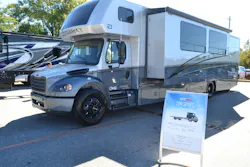
In conjunction with the facility tour, FCCC announced a partnership with Roush Power Systems (a newly formed division of Roush) to engineer and launch a next-generation front-engine Class A gasoline RV chassis. Scheduled to enter full production in January 2028, the new platform will integrate General Motors' 6.6-liter gasoline engine paired with an Allison transmission.
Designed specifically for entry-level and mid-range Class A motorhomes, the chassis will feature FCCC’s proprietary DriveTech digital display, V-Series suspension system, UltraSteer tag axle, and BrakeSync air system.
DTSV also is advancing a multi-fuel strategy across its bus and commercial lines:
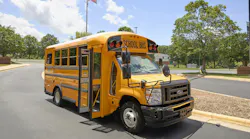
- Cummins Octane Engine: TBB is completing validation testing to launch the Cummins Octane engine in the Saf-T-Liner C2 school bus in 2027, expanding customer choices alongside clean diesel and zero-emission electric options.
- Second-Generation Battery Electric Vehicles (BEV): TBB is in full production on the Saf-T-Liner C2 Jouley Gen 2.0, featuring an integrated electric axle (eAxle) and doubled battery voltage for improved torque, acceleration, and range. In early 2027, DTSV will expand this Gen 2.0 eAxle electric architecture to its Type D transit bus platform.
Flagship Factory Service Center
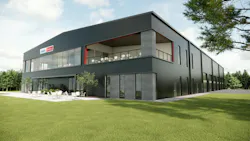
Also on the tour, FCCC announced plans to construct a flagship Factory Service Center adjacent to its headquarters and manufacturing complex in Gaffney. Groundbreaking is planned for late 2026, with an expected opening in the fourth quarter of 2027.
“Our Factory Service Center will set a new standard by strengthening our commitment to providing the most comprehensive service and ownership experience in the industry,” said Akbar Ghous, vice president of sales and marketing for FCCC. “People pick products powered by FCCC for many reasons, with service being one of the most important. Our new Factory Service Center will offer RVers an experienced and expert team, incredible amenities and an experience that will feel like so much more than just a service stop. It will be a welcoming, world-class respite for RVers.”
The facility highlights include:
- 12 dedicated RV service bays across more than 18,000 square feet of service space.
- 30+ secure RV parking bays outfitted with electric and water hookups.
- 16,000 square feet of office space for team members, alongside dedicated outdoor grounds for hosting RV rallies and industry events.
- Dedicated classrooms for Camp Freightliner, FCCC's two-day owner training course on chassis maintenance and operation.
- Integration with FCCC’s broader support ecosystem, which includes over 450 Freightliner service locations, more than 100 Oasis RV centers, 24/7 factory-direct phone support, and a mobile customer app.