The digital parts counter

Downtime is the ultimate enemy for commercial vehicle operators, and quite often the battle is won or lost at the parts counter. That’s the front line where service and repair specialists, distributors, and component manufacturers come together to deliver immediate solutions.
Historically, keeping trucks and trailers moving relied on the hard-won knowledge of veteran counter personnel who spent decades memorizing part cross-references, fitment nuances, and pricing structures. Today, that traditional operating model is under siege: those experienced specialists are retiring at a record pace, while digital-savvt fleet customers demand instant, accurate, and transparent buying experiences.
To address this structural shift, MEMA Aftermarket Suppliers convened a Commercial Vehicle Pulse webinar featuring Shannon O’Brien, senior director of commercial vehicle programming at MEMA; Ram ChandraSekar, founder and CEO of PhaseZero AI, an agentic AI commerce platform provider; and Bill Nunnery, senior director of aftermarket (Americas region) at Dana Incorporated.
Their message to heavy-duty suppliers and distributors: In modern commercial vehicle markets, high-quality components and sound cataloging are merely “table stakes”—delivering a friction-free, digitally connected buying experience is what ultimately wins parts sales.
And new AI tools will make parts easier to find, buy, sell, and support.
AI is changing parts search
Across the heavy-duty aftermarket, organizations manage massive portfolios encompassing hundreds of thousands or even millions of SKUs. However, an estimated 92% of organizations have taken no formal action to capture institutional fitment, interchange, and pricing expertise before senior employees retire. As these industry veterans walk out the door, companies are left with significant knowledge gaps that legacy software cannot fill.
Compounding this loss of human capital is the pervasive issue of fragmented enterprise data. Supplier and distributor catalogs are frequently riddled with missing product attributes, inconsistent categorization, incomplete descriptions, and absent visual assets.
When catalog and enterprise resource planning (ERP) systems remain disconnected, internal employees are forced to act as a "human integration layer.” Sales representatives, catalog managers, and customer service teams spend hours toggling across multiple ERP screens, placing internal phone calls, sending emails, and seeking out senior colleagues just to answer routine inquiries regarding part fitment, stock availability, or order status. Every manual touchpoint introduces operational friction, increases costs, and delays customer response times.
At the same time, the search for replacement components is undergoing a fundamental transformation. While standard search engines and supplier websites remain widely used, buyers are increasingly turning to generative AI assistants such as Microsoft Copilot, ChatGPT, Claude, and Gemini, as Chandra explained.
Through emerging integration frameworks like the Model Context Protocol (MCP), these AI tools can securely query private enterprise business data—such as live inventory, customer-specific pricing, and proprietary catalogs—rather than relying on generalized public web content.
This shift accommodates the complex realities of commercial vehicle parts procurement. Unlike light-vehicle buyers who typically search by year/make/model, heavy-duty buyers frequently begin their search with whatever information is available on the shop floor: a VMRS code, a technical specification, an old competitor part number, or a worn physical component sitting on the counter.
During the presentation, PhaseZero demonstrated its Visual Search agent operating directly within an AI workspace like Claude. A user can simply take a photo of an unmarked or damaged part and upload it. In seconds, the visual AI agent scans more than one million industrial parts, presents ranked matches with confidence scores, and provides a direct link to the product detail page showing real-time inventory—such as 86 units available and ready to ship.
Keeping it real
Chandra highlighted a non-negotiable boundary for technology deployment: AI must never be allowed to invent or hallucinate fitment and interchange relationships. Application fitment and cross-reference truth must always originate from verified industry catalog data.
The role of AI is to connect that verified data with real-time inventory, customer-specific pricing, and the companion products required to complete a specific repair job.
But finding the correct part number is only half the equation.
“This is a situation everyone in our industry already recognizes,” Chandra said. “The customer has found the right part and is ready to buy, but it is not available in the location that the customer wants on that particular day. So what happens next?”
Nunnery, in turn, detailed how Dana addresses inventory constraints across its network of 10 distribution centers. By establishing real-time inventory visibility across all warehouses and deploying APIs to link distributor and supplier systems, companies can locate stock across the broader supply chain. If a customer's primary distribution center lacks inventory, intelligent commerce platforms can locate parts at secondary distribution centers or recommend qualified, fulfillable alternative parts.
“It's just it's leveraging the technology that's out there, whether it's using APIs or AI to identify where that inventory is,” Nunnery said. “Typically, somebody has a part somewhere. It's identifying it and moving it quickly to where it needs to be.”
And when an immediate order cannot be fulfilled, enterprise AI transforms that stockout into an actionable demand signal. Instead of allowing unfulfilled searches to disappear unrecorded, AI inventory agents capture lost demand, evaluate the revenue opportunity, and automatically alert account managers.
Sales and supply chain teams can then coordinate proactively to fulfill the order, retaining both the customer relationship and the sale.
Streamlining commerce, post-sale support
Winning B2B orders requires making routine purchasing completely effortless.
Heavy-duty purchasing is characterized by high-volume, repeat transactions. Suppliers and distributors must offer flexible ordering mechanisms—including digital order pads, quick reordering from order history, punchout catalogs, and direct system-to-system API integrations—while automatically enforcing contract pricing and business rules in the background.
Once an order is completed, automated self-service portals handle routine post-sale inquiries such as shipment tracking, invoice retrieval, and credit memo access.
Likewise, AI agents—in the same way an experienced parts person would—can suggest related solutions or “companion products” that might be needed to complete a job, or enhance performance.
“The objective is not to push a random, unrelated product. It is to show that relevant products that can help the customer complete the job that is related to the part that he originally came to us with,” Chandra said. “That creates a better buying experience, and that is where AI can help today and lead to more part sales.”
Additionally, Visual AI and automated analytics streamline returns and warranty processing, enabling customer support teams to resolve disputes rapidly.
Analytics engines can also monitor buyer search drop-offs and unfulfilled queries, alerting sales managers when a customer relationship may be at risk so teams can intervene before business shifts to a competitor.
The strategic playbook: outcomes over hype
Implementing enterprise AI does not require replacing core legacy systems. Private enterprise AI operates as an intelligent integration layer on top of existing ERPs, catalog databases, and access control frameworks.
PhaseZero’s architecture unites three core capabilities: CxCommerce (executing transactions), CxAnalytics (identifying commercial growth opportunities), and Business-Ready AI Agents (driving daily workplace efficiency).
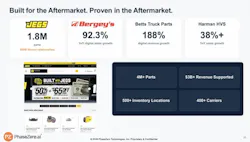
Real-world implementations demonstrate the commercial impact of this approach, with industry distributors such as Bergey's achieving 92.3% year-over-year digital sales growth, Betts Truck Parts generating 188% digital revenue growth, and Harman HVS seeing 38%+ YoY growth, according to Chandra’s presentation.
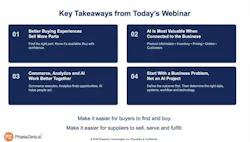
When asked how executives should approach digital transformation, Dana’s Nunnery advised companies to "start with a business problem, not an AI project.” Leadership teams should establish cross-functional alignment groups—such as Dana’s internal "enhancement council"—to identify manual operational bottlenecks, focus on manageable and measurable use cases, and automate routine processes incrementally.
In today's commercial vehicle market, product quality and standard cataloging are expected baseline requirements.
By employing enterprise AI to deliver speed, total inventory visibility, and effortless purchasing experiences, heavy-duty suppliers and distributors can empower their workforce, protect customer relationships, and drive long-term sales growth.
“I do believe if you own the desktop experience, and can provide a great user experience for the customer, ultimately that wins,” Nunnery concluded. “And sometime customers are internal. Again, using technology to drive better efficiency and effectivity inside your company is just so important.”