When hard to electrify becomes hard to ignore
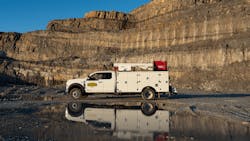
When you’re running a quarry operation, equipment downtime isn’t just inconvenient—it’s expensive. Every minute that a crusher, loader, or haul truck sits idle waiting for repairs costs a company money and can disrupt its entire production schedule. That’s why at my organization, we’ve always prioritized having reliable mobile service capabilities. But as our operations have grown, environmental compliance and our industry’s emission standards tightened, and I started looking for the most likely ways we could reduce our carbon footprint.
I manage all the heavy and support equipment at MidSouth Aggregate, part of CRH’s extensive network of construction materials suppliers. We operate quarries throughout the region, and like most mining operations, we face unique challenges when it comes to mobile maintenance and repair. Our equipment works in harsh, dusty environments, often in remote areas of the quarry where even traditional solutions struggle to perform consistently.
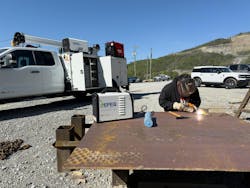
For years, we relied on conventional engine-driven systems to power our mobile service vehicles. You know the setup—a diesel engine running constantly to drive hydraulics, air compressors and welding equipment. It worked, but came with inevitable drawbacks, including excessive fuel consumption from idling and maintenance headaches from equipment running non-stop.
Search for a better solution
About 18 months ago, we were spec’ing out a replacement for one of our aging service trucks, and I started asking questions about alternatives to traditional engine-driven systems. I’d been hearing buzz about electrification in other industries, but honestly, I was skeptical about whether it could handle the demands of a mining environment.
Our requirements were straightforward but challenging. We needed to power a crane for lifting heavy components, run air compression for pneumatic tools and other pneumatic service work, handle field welding for emergency repairs, and do all of this reliably in dirty, demanding conditions. Traditional setups required the truck’s engine to run continuously during service calls, which could mean eight to 10 hours of idling during a day. That’s a lot of wasted fuel and wear on equipment. It also adds a lot of noise and emissions to the already saturated environment of a mining operation.
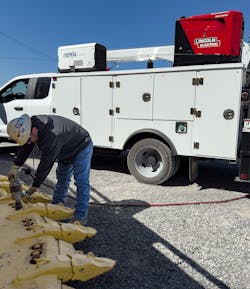
When I started researching electrified power options, Vanair’s EPEQ system kept coming up in conversations. I’ll admit, my first reaction was that it sounded too good to be true. Battery-powered equipment in a quarry? Running welders and cranes? I needed to see it for myself.
Making the decision
After several conversations with Vanair’s team, I decided I needed to see their operation firsthand. We made the trip to Michigan City and toured their entire facility—manufacturing, testing, everything. But what really sold me was when they opened up their R&D Department and let us talk directly with the engineers working on these systems. Those folks could answer the technical questions our team had, and more importantly, they understood real-world applications.
What impressed me most was watching them torture-test components. They showed us the shaker tables, the thermal cycling chambers, the whole works. Seeing products put through extreme heat, cold and constant vibration made me think about our operation. We’re not driving down smooth interstates—we’re on rough terrain, potholes and gravel roads, every day. That kind of abuse is what kills equipment in mining operations. But watching Vanair deliberately punish their components in testing told me these people were serious about building equipment that would last. That visit convinced me they were in this for the long haul, not just selling another piece of equipment.
We decided to build a service truck on a Ford F-550 platform and around several main EPEQ components. First, the Air45 compressor system to handle our pneumatic tool needs and tire service. Second, an EPEQ 140-amp stick welder. Third, an e-PTO system to power the crane hydraulically without running the truck’s main engine. Fourth, Vanair’s EPEQ IM (idle management) technology to intelligently manage when the truck’s engine needed to run versus when we could operate purely on battery power.
We also integrated a Lincoln Electric Ranger 330MPX welder into the setup for our more serious welding tasks. As part of the Lincoln Electric family now, Vanair’s EPEQ equipment is now synonymous with Lincoln’s systems, which was important since both brands are well respected in our industry.
Real-world performance
I’m not going to sugarcoat this—I was nervous when we first deployed the truck. Our operators are experienced mechanics who know what they need, and they weren’t going to tolerate equipment that didn’t perform. But once they saw what the EPEQ system could do, skepticism turned to enthusiasm pretty quickly.
The most immediate impact was noise reduction. When you’re working near operating equipment in a quarry, every decibel matters. Instead of adding to the noise with a constantly running engine, our service truck now operated much more quietly during repairs. Our crew noticed it right away, and it made communication easier on the job site, not to mention less stressful.
Fuel consumption dropped dramatically. Where we used to burn tens of gallons of diesel during a typical eight-hour service call just from idling, we’re now using a fraction of that. The EPEQ IM is smart about when to run the engine to recharge batteries and maintain cabin temperature, versus when to draw from stored power. Over the course of a year, we’re expecting thousands of dollars in fuel savings on just this one truck.
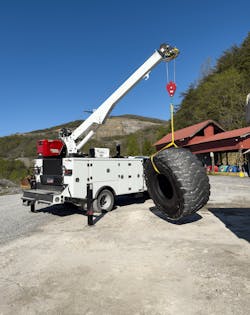
The e-PTO system for the crane has been particularly impressive. We can lift and position heavy components—cylinder heads, transmission assemblies, conveyor sections—all running on battery power. The system delivers smooth, consistent hydraulic pressure without the noise and vibration of a mechanical PTO. Our operators actually prefer it to the old setup because it’s more controllable.
The EPEQ 140 stick welder is great for most tasks, but we use the Lincoln Ranger 330MPX welder for the big jobs. We’re doing structural repairs, fabricating mounting brackets, and handling emergency fixes in the field with the same quality we’d get in our shop. The clean power delivered from the EPEQ system means consistent arc characteristics, which our welders appreciate, and we’ve always got the Ranger there when we need it.
Numbers tell the story
When you’re making capital equipment decisions, return on investment matters. I can’t share exact figures because the data is still coming in, but I can tell you we’re seeing payback faster than I initially projected. Fuel savings alone are substantial, but there are other benefits that are accumulating.
Maintenance costs have decreased because we’re not running the truck’s engine constantly. Less idling means less wear, cleaner oil, and extended service intervals. We’re not expecting to replace engine mounts and exhaust components as frequently. The EPEQ components themselves have required minimal maintenance—basically just routine inspections.
Reliability has been outstanding. We’ve had zero downtime related to the EPEQ system, and as I noted previously, that matters in mining, where equipment availability directly impacts productivity. Our service truck is available when we need it, and it performs consistently.
Lessons for other operations
If you’re considering electrification for mobile service applications, here’s what I’d recommend based on our experience. First, be specific about your power requirements. Understand what equipment you need to run, for how long, and under what conditions. The EPEQ system is modular, so you can configure it for your specific needs rather than taking a one-size-fits-all approach.
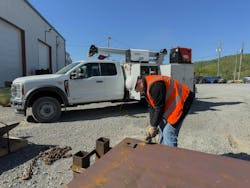
Second, work with a body builder who understands electrified systems. The integration matters. Battery placement, wiring, and accessibility all impact how well the system performs in daily use. Don’t try to retrofit this into an existing truck without proper planning.
Third, prepare your operators. Change can be uncomfortable, even when it’s an improvement. We spent time training our crew on the system and explaining why we made the switch. Once they understood the benefits and saw the performance, they became advocates.
Finally, think long-term. Yes, there’s an upfront cost to electrified systems. But when you factor in fuel savings, reduced maintenance, improved reliability, and better working conditions for your crew, the investment makes sense. We’re already planning to spec our next service truck with EPEQ components.
Looking ahead
The mining and aggregates industry has been slower to adopt electrification than some other sectors, and I understand why. We need equipment that works in tough conditions, and we can’t afford downtime. But based on our experience, electrified mobile power is ready for mining applications. It’s not experimental technology anymore—it’s proven, reliable and cost-effective.
If someone had told me three years ago that we’d have a battery-powered service truck running crane operations in our quarry, I would have been doubtful. But seeing it perform day after day has changed my perspective. This isn’t the future of mobile service equipment—it’s the present. And for operations like ours dealing with demanding applications in harsh environments, it’s a solution that actually works.
Would I recommend this approach to other mining operators? Without hesitation. The technology is there, the economics make sense, and the operational benefits are real. For us, electrifying what seemed like a “hard-to-electrify” application turned out to be one of the better equipment decisions we’ve made in recent years.