ATA urges trucking to stay the course amid ongoing weak demand
SAN DIEGO—It’s hard to ever call the picturesque San Diego Bay gloomy, even on an overcast October day, but the morning economic update on Oct. 27 from Bob Costello, chief economist and SVP for the American Trucking Associations, at the trucking group’s Management Conference and Exhibition, could dampen even the sunniest of dispositions. This day, Costello was the groundhog popping up to tell the crowd there would be six (or more) months of freight recession.
He attributed it to the tariffs President Donald Trump is using as a “blunt tool” to beat back years of global trade inequity. In this trade war, like in any war, “there’s going to be casualties—and it’s going to hurt, especially around U.S. manufacturing,” Costello remarked.
None of this is particularly revelatory to anyone who’s been staying abreast of the latest forecasts from trucking economists. The question is how will the industry’s fleet leaders and other stakeholders, such as truck and trailer manufacturers, respond?
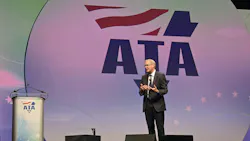
Based on conversation throughout the ATA convention, many in the industry are just waiting for some daylight to break through, something to illuminate the uncertainty. Fittingly, that afternoon as the clouds burned off over the bay and convention center, ATA President and CEO Chris Spear took to the stage for his annual address to members.
Referencing Costello’s earlier report, Spear, too, began with some hard truths.
“We are in a market situation where demand remains low…and capacity is far too high,” Spear began to the packed crowd at the San Diego Convention Center. “And while cyclical freight is not uncommon, this is the third straight year the industry is feeling the pain of a freight recession.”
The downturn is exacerbated by the chaotic political climate, where election results swing the policy pendulum wildly from one extreme to the other, not only for the economy but the regulatory environment as well.
CARB and EPA
Just last year, fleets had to prepare for federal and state emissions rules that would force them to rapidly scale zero-emission vehicle adoption. This year, under President Donald Trump, the EPA is attempting to undo more than a decade of environmental regulations.
And, next year, things could change even more—or stay the same. No one here at MCE really knows for sure. It’s left companies making, operating, and supporting the trucking industry anxious.
“With more than three decades in government relations, I have never witnessed anything close to what we’re navigating right now,” Spear noted.
ATA, though, prefers the anti-regulatory stance of the current administration, with Spear assuring its members the government is here to help trucking.
“President Trump and the Republican-led Congress have wasted zero time moving several ATA priority issues,” he asserted.
Chief among these is the attack on emissions regulations. Trump has undercut California Air Resource Board’s major plans to eliminate ICE engines by removing crucial Clean Air Act waivers, while the EPA is currently trying to remove the Endangerment Finding that serves as the foundation for more than a decade of policies around greenhouse gases.
 dreamstime_l_112471593
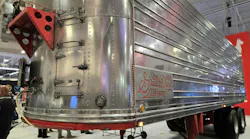 Great Dane's TMC floor display celebrated the trailer manufacturer's 125 years in business.
Trump has also plugged the flow of billions in clean energy funding authorized under the tenure of his predecessor and the previous Congress, who were quick to hand out clean energy funding without considering the implications or feasibility.
“President Biden’s infrastructure bill may have provided 38% more funding for roads and bridges, but it did nothing to build out the electric infrastructure California required, which ended up amounting to a $1 trillion unfunded mandate,” Spear asserted.
Pro-trucking policies
Spear also credited the ATA’s efforts as vital to helping Congress finally see the light in regards to policies harming trucking, and thus the nation’s economy.
“We were the key witness in countless hearings before the House and Senate, telling lawmakers how California’s bark-licking bureaucrats might as well be forcing us to move the nation’s freight with donkey carts,” Spear offered, garnering a chuckle from the crowd. “That’s advocacy at its best, and it’s paved the way for certainty, growth, and a sustainable future for our industry and the environment.
But trucking has “one last major domino to fall”: EPA’s Low NOx rule —possibly “effective,” but untested, and “littered” with added costs per truck.
The emissions fight is ongoing, with CARB and supporters looking to stall or reverse the EPA’s emissions regulation rollbacks. And as ATRI’s latest list of top fleet concerns highlights, lawsuit abuse and related insurance costs are as painful for trucking as the poor economy.
“Our success this year is a reflection of who we are, what we stand for, and what it all means to the more than 340 million Americans who depend on trucking each day,” he said. “That reflection is reality.”
Lawsuit abuse
Additionally, Spear highlighted ATA’s work on one of its tier-1 issues, what he called “declaring war on the trial bar.”
ATA will continue to encourage states to pass tort reform, while also aiming for federal reforms. In particular, he pointed to the “Lawsuit Abuse Reduction Act,” introduced in September.
“For the first time, ATA is putting a secondary lawsuit abuse strategy to advance federal legislation into full motion, further kicking the plaintiffs’ bar to the curb,” Spear said.
Looking forward
Even with these gains, the association is keeping an eye on how the economy is continuing to impact fleets, including the administration’s use of tariffs.
“ATA has and will continue to oppose any elevating use of tariffs that adversely impact the movement of freight,” he asserted. “The President, however, believes strongly in tariffs as a policy tool. That’s not going to change.”
That said, ATA will continue to object to this tactic—without undoing the association’s work on other fronts. If the current tariffs extend the freight recession, “ATA may well consider strategic shifts” to address those impacts.
Ultimately, Spear ended his speech on a more positive note than he began it, with a focus on ATA’s determination to continue advocating for trucking.
“Stay the course,” he concluded. “Don’t concede anything to the plaintiffs’ bar and union bosses. Like you, ATA is doing more with less, and we’ll continue that as long as it takes.”
About the Author
 John Hitch
John Hitch
Editor-in-chief, Fleet Maintenance, Senior Editor, Trailer-Body Builders
John Hitch is the editor-in-chief of Fleet Maintenance, where his mission is to provide maintenance management and technicians with the the latest information on the tools and strategies to keep their fleets' commercial vehicles moving.
He is based out of Cleveland, Ohio, and has worked in the B2B journalism space for more than a decade.
Hitch was previously senior editor for FleetOwner, and covers everything related to trucking and commercial vehicle equipment, including breaking news, the latest trends and best practices. He previously wrote about manufacturing and advanced technology for IndustryWeek and New Equipment Digest.
Prior to that he was editor for Kent State University's student magazine, The Burr, and a freelancer for Cleveland Magazine. He is an award-winning journalist and former sonar technician, where he served honorably aboard the fast-attack submarine USS Oklahoma City (SSN-723).