Trailer orders slip, but production improves
Key Highlights
- U.S. trailer orders fell 45% in February, significantly below the 10-year average, indicating cautious industry outlook.
- Order backlogs declined slightly, reflecting weak near-term demand and ongoing industry headwinds.
- High input costs, tariff uncertainties, and limited capital spending are constraining trailer demand despite improving freight fundamentals.
- Trailer production increased 20% month-over-month but remains flat year-over-year, with OEMs likely to remain conservative in 2026 build plans.
- Trade tensions and tariffs on steel and aluminum continue to impact costs and order volumes in the trailer industry.

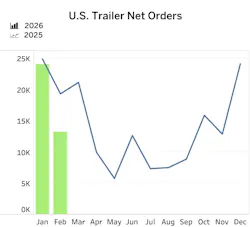
Two steps forward, one step back. U.S. trailer net orders fell sharply in February following back-to-back months of 24,000-plus orders in December and January, according to the latest market update from FTR. The analysis attributed the late 2026 run-up to a delayed start to the 2026 order season.
The sequential decline far exceeded normal seasonality, dropping 45% month-over-month (m/m) to 13,305 units, per FTR. Orders were down a concerning 31% year-over-year and came in well below the 10-year February average of 25,172 units.
Orders for the 2026 U.S. trailer order season (September 2025-February 2026) are now down 19% y/y.
Trailer demand remains largely at replacement levels as fleets still have sufficient capacity and are prioritizing Class 8 purchases, the FTR report noted. Meanwhile, trailer demand continues to face several headwinds—elevated steel and aluminum costs, ongoing tariff uncertainty, persistently high financing costs, constrained capital spending, etc.—that are keeping orders subdued despite notably improving truck freight fundamentals.
“The U.S. trailer market remains under pressure from elevated input costs and ongoing trade uncertainty,” Dan Moyer, senior analyst, commercial vehicles, said. “Section 232 tariffs on steel, aluminum, and derivative products remain in place. Despite the U.S. Supreme Court’s February ruling striking down the administration’s country-specific tariffs that relied on emergency powers, replacement tariffs of 10% under other authority took their place. Trade pressures are also intensifying in the van segment due to an ongoing antidumping and countervailing duty investigation.”
Total U.S. trailer builds in February increased 20% m/m to 15,199 units, roughly in line with February 2025 production levels, and build was flat y/y. However, with orders for 2026 production trending notably lower y/y, OEMs are likely to remain conservative in their 2026 build plans, FTR concluded.
Backlogs weak
Indeed, the February order reversal resulted in backlogs falling 1.5% sequentially, or about 1.1k units, according to the monthly report from ACT Research.
“Given the annual order cycle is coming to an end, and it’s now typically the time to build down the backlog, the question remains truckers’ near-term appetite for trailers,” said Jennifer McNealy, director–CV market research and publications at ACT Research. “Much like 2025, the issue today remains a shallow backlog.”
In addition to weak backlogs, McNealy also pointed to financing concerns, tariffs known, the uncertainty of tariffs to come, weak carrier profits, and low levels of capital spending balanced against high input costs (metals in particular).
“Those on the front lines are waiting, knowing a ramp in demand is coming but worried about the industry’s ability to meet it if it is too steep and quick,” McNealy cautioned.