Wabash ramps up: Losses continue, but OEM bets on recovery win
Key Highlights
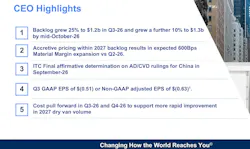
- Q3 consolidated net sales increased 24.8% year over year to $476.4 million, while gross profit was $14.9 million.
- New trailer shipments rose 43.3% to 9,563 units, while truck body shipments fell 45.1% to 1,685 units.
- Total backlog reached $1.3 billion by mid-October, and 2027 dry van orders surpassed 20,000 units.
- Wabash is preparing for annualized dry van capacity of 42,000–45,000 units and forecasts 35,000–38,000 shipments in 2027.
- Trade duties on imported trailers and stronger order pricing are expected to support domestic producers and improve margins.
While Wabash Q3 earnings continued to reflect the short-term cost drag of bottom-of-cycle conditions and deliberate operational investments, an atypical surge in order backlog and recent federal trade rulings provided strong evidence that a multi-year dry van recovery is under way.
"Our third quarter results represent another step forward in what continues to be a transition year for Wabash," Brent Yeagy, president and CEO, said. "Beneath the results we have explicit and material evidence in demonstrated customer demand. That gives confidence that the conditions required for a broader recovery are solidly in place. As a direct result of customer order activity at scale, we aggressively pulled forward capacity addition actions into Q3, actions previously slated for Q1 and Q2 of 2027, to increase dry van output in direct response.”
Consolidated net sales for the third quarter reached $476.4 million, representing a 24.8% year-over-year increase compared to the prior-year period and exceeding management’s guidance range. The top-line gain was propelled by a sharp rebound in core trailer volume, as new trailer shipments rose 43.3% year-over-year to 9,563 units. Truck body shipments, however, remained depressed at 1,685 units, down 45.1% year-over-year, reflecting ongoing weakness in consumer discretionary and regional delivery segments.
Consolidated gross profit for the quarter stood at $14.9 million, or 3.1% of sales. On a GAAP basis, Wabash recorded an operating loss of $20 million, which included a $7.5 million gain from the sale of a manufacturing facility in Goshen, Indiana.
Segment performance highlighted the divergence across product categories:
- Transportation Solutions: Generated $407.9 million in revenue (up 21.9% year-over-year), but recorded an adjusted operating loss of $(14.4) million due to customer mix and low fixed-cost absorption during the initial production ramp.
- Parts & Services: Delivered $69.4 million in revenue (up 13.8% year-over-year and 9% sequentially), generating $5.6 million in adjusted operating income. Segment profitability continued to absorb startup expenses from new upfit centers in Chicago, Atlanta, and Phoenix, which are expected to normalize as site utilization scales.
Trucking fundamentals
A central narrative of the Q3 earnings call was the dramatic strengthening of order momentum entering the 2027 booking cycle. Management pointed to broader freight indicators—including rising spot rates, elevated tender rejection rates, contracting carrier capacity, and an aging national trailer fleet—as catalysts compelling fleets to resume equipment replacement, company executives explained in a conference call with investment analysts.
Wabash’s total backlog grew 25% sequentially during Q3 to reach $1.198 billion. Rather than slowing after quarter-end, order intake accelerated further, pushing total backlog to $1.3 billion by mid-October.
Within the core dry van segment, 2027 order commitments climbed from 12,000 units prior to quarter-end to nearly 16,000 units by September 30, and surpassed 20,000 units by mid-October. Based on historical ordering patterns, Yeagy projected that Wabash is on track for 35,000 to 38,000 dry van unit shipments in 2027, reflecting a baseline replacement market of 135,000 to 140,000 industry units and maintaining Wabash’s target ~25% market share.
Across all product lines (including tanks and flatbeds), total trailer volume is projected to exceed 41,000 to 42,000 units.
This demand expansion is occurring alongside improving pricing power, Yeagy noted. Weighted average material margins within the 2027 order portfolio are currently averaging more than 600 basis points higher than Q2 2026 levels, reflecting better alignment between contract pricing and input costs.
Trade policy and tariffs
Wabash’s outlook for 2027 and beyond is significantly bolstered by favorable international trade determinations that management expects will level the domestic competitive playing field.
On September 25, the U.S. International Trade Commission (USITC) issued a final affirmative determination confirming that imports of van-type trailers and sub-assemblies from China cause material injury to domestic producers.
The resulting trade remedy structure imposes formidable barriers on foreign imports:
- Chinese imports: Anti-dumping (AD) duties of ~130% and countervailing duties (CVD) of ~135%, when stacked with existing 25% Section 232 tariffs, create an effective combined duty rate of approximately 290%.
- CMexican and Canadian competitors: Preliminary affirmative determinations have established cash deposit requirements, with a combined AD/CVD rate of ~10.2% applied to major foreign competitors such as Hyundai, resulting in a stacked effective tariff rate of approximately 35%.
Wabash procures approximately 95% of its materials domestically, making the manufacturer insulated from import tariffs while benefiting directly from industry-wide pricing discipline, Yeagy added. The company’s Lafayette South plant expansion provides approximately 10,000 incremental units of scalable dry van capacity without requiring additional major capital expenditure.
Pulling forward 2027 costs
To ensure seamless execution as high-volume production begins, management made the deliberate strategic decision to pull forward labor onboarding and facility preparation costs from Q1 and Q2 of 2027 into the third and fourth quarters of 2026, company leadership emphasized on the call.
During Q3, Wabash expanded its dry van hourly workforce by 15% and initiated shift additions across nearly all assembly lines. By the end of Q4, the company plans to have second shifts fully operational across its primary footprint, establishing an annualized dry van production capacity of 42,000 to 45,000 units.
While absorbing these onboarding expenses ahead of revenue recognition pushes positive EBITDA out of late 2026, management emphasized that this investment ensures rapid margin expansion in early 2027. Wabash expects strong incremental margins exceeding 20% starting in Q1 2027.
Looking ahead to 2027, management anticipates a strong, dry-van-led market recovery. While the truck body segment is expected to lag dry vans by six to nine months, Parts & Services is positioned to maintain a 5% to 10% revenue growth trajectory with mid-teens operating margins as startup drag subsides.
By leveraging trade policy tailwinds, expanding domestic capacity, and proactively funding labor readiness, Wabash has positioned itself to transition rapidly from cycle-trough defense to accelerated market share gains and margin recovery in 2027.