July trailer orders defy summer lull
It wasn't quite Christmas in July, the trailer manufacturers recently received an unexpected gift: The U.S. heavy-duty trailer market experienced an unexpected mid-summer surge in July, defying the traditional seasonal slowdown. Both major industry analysts, FTR and ACT Research, reported significant month-over-month and year-over-year gains in net orders, pointing to a firming demand backdrop and a shift in procurement cycles.
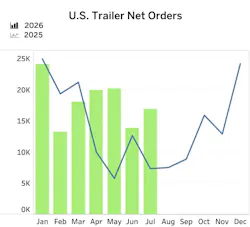
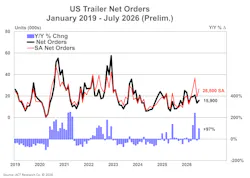
According to preliminary estimates from ACT Research, July net trailer orders reached 15,900 units, representing an 18% month-over-month increase and a massive 97% jump compared to July 2025’s tepid environment. When seasonally adjusted, ACT projects this volume reaches 26,500 units.
FTR’s data echoed this upward trend, reporting net orders at 16,862 units—a 22% month-over-month increase and a 130% surge year-over-year. This output landed 23% above the 10-year July historical average of 13,665 units.
Year-to-date, net orders are up 25% compared to the same period last year.
Tariffs, fundamentals, and replacement cycles
July is historically the weakest month of the annual trailer ordering cycle. However, this year’s cycle has been highly atypical, with the order strength that usually starts in autumn delaying until December.
“This year’s cycle has been anything but ordinary: the order strength that should have started in September or October of last year didn’t actually begin until December," said Jennifer McNealy, director of CV market research at ACT Research. "The atypical strength in orders continues to reflect improving trucking fundamentals, buttressed by rising freight rates.”
According to OEM feedback, three primary catalysts are driving this counter-seasonal surge:
- Pre-buying ahead of tariff-related price increases: Fleet buyers are acting to avoid mounting cost pressures from April’s Section 232 steel and aluminum tariff changes. Additional pressures stem from ongoing antidumping and countervailing duty investigations into van equipment sourced from Canada, Mexico, and China.
- Healthy long-term conditions: Improving freight rates are bolstering carrier confidence.
- Pent-up replacement demand: Fleets are finally addressing deferred equipment upgrades.
Dan Moyer, Senior Analyst at FTR, warns that while these trade actions may benefit some domestic trailer manufacturers, they are also likely to alter ordering timelines rather than spark organic expansion.
"Trade-related cost pressures continue to build on multiple fronts, including April’s changes on how Section 232 tariffs on steel and aluminum are applied and the ongoing antidumping and countervailing duty investigations related specifically to van equipment sourced from Mexico, Canada, and China," Moyer said. "Fleets likely will see higher costs. Overall, these actions are more likely to change where trailers and components are sourced, what they cost, and when fleets order than to create additional underlying demand.”
Production tightens as backlogs stabilize
In contrast to rising order volumes, trailer production contracted in July. July builds fell 11% month-over-month and 9% year-over-year to 16,195 units. This brings year-to-date output to 113,969 units, down 1% from the previous year.
For-hire fleets have historically prioritized investments in new power units over trailers, leading to a disconnect between truck and trailer demand. Despite this, because net orders outpaced production in July, backlogs are seeing stabilizing pressures.
Looking ahead
While freight rates are projected to rise well into 2027, many carriers remain cautious. High maintenance and downtime repair costs continue to serve as a counter-weight to purchasing new units, especially as fleets navigate tight profit margins from previous years.
With most OEMs yet to open 2027 order calendars, the current order velocity remains premature for next-year planning, setting up a potentially choppy market until the formal order season commences around September, according to the analysts.