Trailers orders close Q1 with surge
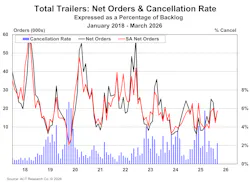
Three months into 2026, the U.S. trailer industry remains mired in the same challenging environment in which it operated throughout 2025.
“Demand for trailers improved in March, but demand was weak across Q1,” said Jennifer McNealy, director–CV Market Research & Publications at ACT Research. “Carrier profits, although benefitting from an uptick in freight rates and a tightening driver pool, remain low, with government policy and geopolitical instabilities keeping customers cautious.”
With equipment demand fundamentals transitioning in Q1, net order intake in March jumped to 18,800 units, up more than 42% from February. This brought the Q1 2026 order total to 55,400 trailers, about 9% less than were ordered during the first quarter of 2025.
FTR likewise reported that U.S. trailer demand in March came in stronger than expected as net orders rose a “surprising” 36% month over month to 18,045 units but remained down 15% year over year.
“Despite the healthy increase in orders, trailer demand remains largely replacement driven as fleets still have excess trailer capacity,” said Dan Moyer, senior analyst, commercial vehicles. “In contrast, Class 8 demand has strengthened meaningfully, supported by improving asset utilization, firmer rate expectations, and better visibility into tariff-adjusted pricing and EPA 2027 NOx regulations—all of which combine to drive an early-cycle recovery in orders. As a result, fleet capital allocation is increasingly shifting toward power units aligned with forward-looking needs, leaving trailers relatively deprioritized despite improved freight market conditions.
“Meanwhile, the U.S. trailer market continues to face persistent headwinds. Elevated steel and aluminum costs, ongoing trade uncertainty, high financing costs, and constrained capital spending are limiting incremental demand and keeping orders subdued.”
Cancellations, backlogs
Cancellations “gyrated” throughout 2025, before returning to a “more subdued rate” to start 2026, McNealy noted. March’s rate of 2.3%, as a percentage of backlog, returned the industry cancellations to ‘elevated’ territory from the middle of the acceptable range reported last month.
Unlike the last few months, though, data in March showed high cancellations in nearly all segments, per ACT Research.
“After a one-month hiccup in February, net orders again outpaced build in March, but this time it wasn’t by enough to pump much lifeblood into the anemic backlogs,” McNealy said.
Backlogs grew 3% sequentially, or about 2.2k units, bringing the Q1-ending BL to 76.4k units, or 23% lower than the Q1’25-ending, 99.3k-unit trailer backlog. The backlog-to-build ratio was 4.7 months at the end of 2026’s first quarter.